
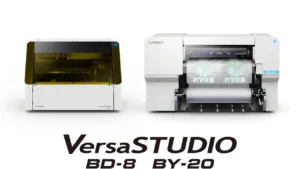
The customization world just got more interesting.
Roland DGA Corporation has officially introduced its UV DTF (Direct-to-Film) Transfer System, adding another serious tool to the growing arsenal of digital decorators, small shops, and scalable production environments.
If you’ve been following the rise of UV printing, laser engraving, and DTF apparel, you already know what’s happening: personalization is no longer niche — it’s expected. And Roland stepping into UV DTF in a focused way tells us something important.
This isn’t a gimmick product.
It’s a market shift.
Let’s break down what this means — both technically and strategically — especially if you’re building or scaling a digital manufacturing business.
What Is UV DTF — And Why Is Everyone Talking About It?
UV DTF (Direct-to-Film) is a process that allows you to:
- Print a UV-cured graphic onto a specialized transfer film
- Laminate it
- Apply it to hard goods
- Peel and leave behind a durable, full-color graphic
No heat press.
No weeding.
No direct substrate printing required.
This is huge for makers who:
- Sell tumblers
- Decorate glassware
- Personalize promotional products
- Customize acrylic, wood, plastic, leather, and coated metals
Traditional UV printers require you to print directly onto the item. That’s powerful — but it limits you to flat surfaces or requires expensive jigs for curved items.
UV DTF changes that.
You print once. Apply anywhere.
Why Roland Entering UV DTF Matters
Roland DG Corporation has been a dominant force in large-format print and UV technology for decades. When a company with that kind of reputation enters a category, it signals:
- The technology is maturing
- Demand is strong
- Commercial shops are ready for it
- Reliability expectations are rising
Roland is not a “quick cash-grab hardware” company. Their machines are typically positioned for professional environments — sign shops, print providers, production facilities.
So this release tells us UV DTF isn’t just for hobbyists anymore.
It’s entering mainstream production.
What the Roland UV DTF System Brings to the Table
While exact model configurations may vary, Roland’s UV DTF system focuses on:
✔ Integrated Workflow
Designed for streamlined printing + laminating + curing.
✔ CMYK + White + Gloss Capabilities
This allows for:
- Vibrant color
- Opaque underlays
- Texture or spot gloss effects
That gloss channel is where things get interesting. You can create raised effects, highlights, and dimensional branding — without engraving.
✔ Commercial-Grade Reliability
Roland’s engineering historically emphasizes:
- Consistent ink delivery
- Stable curing
- Production uptime
For a business owner, uptime equals revenue.
Where This Fits in a Digital Manufacturing Business
Now let’s look at this through a Laticy lens.
If you’re building:
- A trade show personalization booth
- An Etsy brand focused on hard goods
- A corporate promotional product shop
- A B2B customization service
UV DTF creates a new product layer.
Instead of investing in:
- Multiple laser systems
- Multiple substrate types
- Custom jigs for curved items
You can produce transfers in bulk and apply them as needed.
That changes your operational model.
It separates production from fulfillment.
You can print 500 transfers in one controlled environment — then apply them on demand.
How This Compares to Traditional UV Flatbeds
Traditional UV Flatbed:
- Print directly on object
- Limited by surface height and shape
- Requires object positioning
UV DTF:
- Print on film
- Apply to nearly any smooth hard surface
- Faster application for curved items
For someone starting out, UV DTF may reduce complexity.
For someone scaling, it increases flexibility.
Competitive Landscape
UV DTF is already popular among:
- Chinese OEM manufacturers
- White-label import brands
- Smaller UV printer companies
What Roland brings is:
- Brand trust
- Technical support
- Established dealer network
- Commercial credibility
That matters if you’re servicing corporate clients or scaling B2B.
When you tell a corporate buyer your system is Roland-based, that carries weight.
Who This Is Best For
Let’s be honest — this likely isn’t a “garage side hustle” entry machine.
This is ideal for:
- Established print shops
- Growing customization brands
- Promotional product distributors
- Commercial sign businesses expanding offerings
If your revenue depends on consistency, reliability, and scalable output — Roland entering this space is something you should be paying attention to.
The Bigger Industry Trend
This release reinforces something we’ve been tracking at Laticy:
The future of digital manufacturing is hybrid.
Laser + UV
Print + Transfer
Production + On-Demand
The shops that win over the next five years won’t be locked into one technology.
They’ll layer capabilities.
UV DTF doesn’t replace lasers.
It complements them.
Laser engraving creates depth and permanence.
UV DTF creates color, speed, and flexibility.
Together? That’s a powerful business model.
Strategic Questions to Ask Before Investing
If you’re considering UV DTF (Roland or otherwise), ask yourself:
- Do I need high volume transfer production?
- Am I servicing B2B clients?
- Do I want to decouple printing from application?
- Do I need gloss / texture effects?
- Can my current workflow support film inventory management?
Technology is only powerful if it aligns with your business model.
Final Thoughts from Laticy
Roland entering UV DTF isn’t just another product announcement.
It’s validation.
Validation that:
- Custom hard goods are growing.
- Transfer workflows are here to stay.
- Professional-grade UV DTF is moving mainstream.
If you’re building a serious digital fabrication business, this category deserves research — even if you’re not ready to invest today.
The smart operators watch trends early.
They learn the workflows.
They plan the expansion before the demand spike.
And whether you’re running a small shop or building a scalable production brand — staying informed is part of staying competitive.
We’ll continue monitoring how this system performs in real-world environments and where it fits best in modern maker businesses.
Because at the end of the day, tools matter.
But strategy matters more.
— Laticy.com
[…] 👉 Roland UV DTF Transfer System Reviewhttps://laticy.com/roland-uv-dtf-transfer-system/ […]