
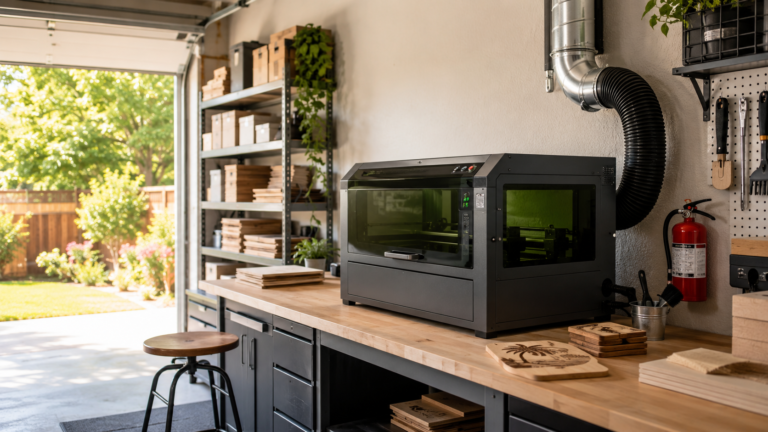
A home laser setup can work well for a small business, but only if you treat safety and airflow as part of the shop, not as accessories you buy later. Summer heat, heavier production, and garage airflow changes make that especially important.
Important note: This article is practical operator guidance, not legal, medical, or fire-code advice. Always follow your machine manufacturer’s instructions, use verified materials, and check local requirements for home businesses, ventilation, and fire safety.
A lot of home-based laser businesses start with the same assumption: if the machine fits on a bench, the shop is basically ready.
That’s usually the wrong assumption.
A laser setup isn’t just a machine purchase. It’s a small production environment. The machine matters, of course, but so do ventilation, smoke direction, material choice, fire readiness, supervision, cleanup, heat, pets, kids, and the way orders move through your space.
Summer is when weak spots show up fastest. Garages get hotter. Filters load up faster. Smoke smell travels farther. The open-door workaround that felt fine in spring can turn into an airflow, security, or weather problem once production gets busier.
If you’re running a laser engraver at home or in a garage, this is a good time to fix the basics before summer production ramps up.
If you’re still early in the buying stage, start with Beginner’s Guide to Laser Machines. If you’re comparing machines for a shop setup, Best Laser Engraver for Small Business in 2026 is the better next stop. If budget is the main pressure point, Can a Budget Laser Engraver Actually Support a Business? helps frame what corners are safe to cut and which ones aren’t.
The Short Version
Home laser work can absolutely support a small business, but it stops being “just a hobby machine” the moment you depend on it for customer orders.
That means you need to think beyond engraving quality. You need a controlled way to move fumes out, a clear rule for what materials are allowed near the machine, a plan for smoke and odor, active monitoring while the job runs, and a shop layout that still works when the weather is hot and your order volume climbs.
The biggest mistake is treating ventilation and filtration as the same thing. They’re related, but they aren’t interchangeable.
Ventilation is about moving contaminated air out of the work area. Filtration can reduce some particles or odors, depending on the system, but it doesn’t magically make every material safe to process indoors. That’s especially important if your laser is in a spare room, basement, attached garage, or any space that shares air with the rest of the home.
Why Summer Exposes Bad Laser Habits
A laser setup that seems acceptable in cooler months can become frustrating fast in June, July, and August.
Garages and small shops often run much hotter than people expect. Higher ambient heat can make the operator more tired, can push equipment into a less comfortable range, and can make smoke smell cling to the space longer.
Open doors and windows may seem like an easy answer, but they can also change airflow in ways that pull smoke back toward the operator, push odor toward neighbors, or interfere with the way your exhaust system normally works.
Summer also tends to bring more production pressure. Market season, teacher gifts, wedding items, vacation personalization, signage, and event orders can all stack up at once.
When volume increases, little safety shortcuts become repeated habits: one more job before cleaning, one more offcut near the bed, one more run while you answer messages in another room.
That’s how “it has been fine so far” turns into a real problem.
Ventilation Comes First, Filtration Comes Second
If you remember one thing from this article, let it be this: venting a laser safely isn’t the same as putting a filter box next to it.
A better ventilation setup tries to capture fumes and move them out of the occupied space in a controlled direction. In practical terms, that usually means an enclosure or closed machine, ducting, an inline fan or extractor sized for the setup, sealed or mostly sealed connections, and an exhaust path that doesn’t simply dump smoke where it drifts back indoors.
Filtration can be useful, especially for reducing particulates and smell when used with the right equipment and maintenance. But filtration isn’t a universal permission slip.
Some fumes are a material problem first, not just an odor problem. If the material shouldn’t be cut or engraved, no consumer filter setup turns that into a good idea.
This matters because new operators often think in reverse. They buy a machine, notice smoke, then look for a purifier that promises to solve everything.
A better order is to start with verified safe materials, contain smoke as well as the machine allows, build a direct exhaust path, then add filtration only when it actually fits the workflow.
And if you use filters, treat replacement as part of the cost of running the shop. A dirty filter isn’t the same system you bought on day one.
If your machine is in an attached garage, a room above living space, or anywhere the smell quickly reaches the house, that isn’t a minor comfort issue. It’s a sign to re-check the whole airflow path.
Materials Are the First Real Safety Decision
The safest ventilation setup in the world doesn’t make bad material choices okay.
For a home business, your materials policy should be boring, strict, and easy to follow. Only run materials you can identify and that your machine and manufacturer guidance support.
Don’t cut or engrave PVC, vinyl, chlorinated plastics, unknown plastics, or coated and treated materials unless you’ve reliable verification that they’re appropriate for laser processing.
If you can’t identify it, don’t put it in the machine just because it was cheap, free, or already in the garage.
That warning matters more during busy seasons because production stress makes people experimental in the wrong way. A scrap bin full of mystery material isn’t inventory. It’s a risk pile.
The same caution applies to finishes, adhesives, laminates, painted surfaces, and pressure-treated or chemically treated materials. A sheet that looks similar to one you used last month may not be the same product.
A coated tumbler, sign blank, faux leather sheet, or acrylic substitute from an unfamiliar seller can behave differently than expected.
Good production shops usually keep a simple rule: verified material list, labeled storage, and a separate “don’t run until confirmed” area.
Fire Readiness Isn’t Optional
Laser work needs active supervision.
That sounds obvious, but many small operators slowly drift into semi-attended production, especially with familiar files. A job that worked 50 times can still flare up on the 51st because a sheet warped, residue built up, air assist changed, masking lifted, or the material itself varied.
You don’t need to sound paranoid to say this clearly: don’t run a laser and leave it alone. Stay close enough to intervene quickly.
A home laser business should have a reachable extinguisher appropriate for the workspace, not one buried behind inventory. Smoke alarms or air monitors can be useful, but they’re backup, not the main safety system.
If an alarm is the first sign you’ve of a problem, you noticed too late.
The area around the machine matters too. Extra cardboard, dust, scraps, paper towels, solvents, packing material, and random offcuts don’t belong near active laser work.
Lens areas, honeycombs, crumb trays, ducts, and work surfaces collect residue. Dirty machines aren’t just ugly. They can increase smell, reduce performance, and raise the chance that a small flare becomes a larger mess.
If your machine uses air assist, keep it maintained and working as intended. Weak airflow, clogged lines, or neglected consumables can hurt cut quality and smoke control.
Monitoring Is a Workflow Problem
One of the fastest ways a home laser business gets sloppy is by stacking too many tasks on top of a running machine.
You start a cut, answer email, package an order, reply to Etsy, run inside for tape, then assume you’re still “nearby enough.” In reality, you’re no longer really monitoring the job.
Busy weeks call for simpler workflow, not looser supervision.
Prep blanks before the machine turns on. Keep masking, cleaning cloths, maintenance supplies, and scrap bins in fixed places. Batch similar jobs when possible so you aren’t constantly changing materials and settings. Use a checklist if you need one.
The goal is to reduce the number of reasons you walk away from an active machine.
For a small shop, safety is often a workflow problem before it becomes a hardware problem.
Smoke Management Is Also a Business Issue
Even when smoke is venting outside, you still need to think about where it goes.
In summer, odor can travel farther because doors are open, people are outside more, and the house or garage may already be warm.
A setup that technically exhausts outdoors can still create problems if the outlet is near a walkway, patio, neighbor line, open window, or garage door that lets the smell curl back in.
That’s one reason open-door production isn’t always the easy fix it seems to be. Opening the garage can change pressure and airflow enough to make your exhaust less predictable.
It can also create security issues if expensive equipment is visible while the machine is running and you’re distracted.
Weather matters too. Wind gusts, humidity, and summer storms don’t care that you promised a customer Friday pickup.
If your current system only works when the door is half open and the wind cooperates, that isn’t a finished system.
Pets, Kids, and Shared-Home Reality
A home shop is different from a detached commercial space because other people and animals move through it.
That changes the standard.
If children or pets can wander near the machine, ducting, hot materials, scrap bins, chemical cleaners, or recently processed pieces, your setup isn’t really controlled yet.
The same goes for family members who assume the garage or spare room is still ordinary household space.
You don’t need a dramatic lockdown. You do need boundaries.
That may mean a dedicated room, a door that stays shut during operation, a machine enclosure that can’t be casually opened, material storage that’s clearly labeled, and a rule that freshly cut or engraved items cool in a managed area instead of on the kitchen table.
This is another place where “small business” thinking helps. The safer shop is usually the one that stops pretending the work area is also general family overflow space.
What to Fix Before Summer Production Ramps Up
If your home laser business is about to get busier, focus on the physical shop checks first.
Re-check Your Exhaust Path
Look at the full route from machine to outlet. Are there loose connections, crushed ducting, long awkward runs, or places where smoke can leak back into the room?
Has dust or residue built up? Does the fan still pull the way it did when the system was new?
Replace Overdue Filters
If you use a filtration unit, pre-filter, or any add-on designed to capture smoke and particulates, don’t treat replacement intervals as optional.
Summer production can load filters faster, and a clogged filter can mean weaker performance plus more smell.
Simplify the Area Around the Machine
Get rid of extra cardboard, packing material, random offcuts, and unverified scraps.
If it doesn’t belong near active laser work, move it.
Confirm Your Approved Materials List
Make sure the materials you plan to run this season are identified, labeled, and separated from anything questionable.
This is a good time to throw away mystery scraps.
Check Your Fire-Response Basics
Know where the extinguisher is. Confirm alarms or monitors are working. Make sure the emergency stop or shutdown routine is obvious.
Plan Around Heat and Operator Fatigue
If the space becomes miserable by mid-afternoon, your judgment gets worse. Plan around the heat instead of pretending it doesn’t matter.
That may mean earlier production windows, better general shop airflow that doesn’t interfere with machine exhaust, or a reduced schedule during peak heat.
The Home-Business Mindset Shift
The main change most operators need isn’t a bigger machine. It’s a more honest definition of the job.
If your laser is making products for paying customers, the setup around the machine is part of the product cost.
Ventilation hardware, enclosure upgrades, ducting, clamps, blast gates, filter replacements, maintenance supplies, safety glasses, air assist upkeep, alarms, and a proper extinguisher aren’t side purchases that make the business look serious.
They’re part of what makes the business real.
That’s also why the supporting business side matters. If you’re trying to organize supplies, recurring maintenance items, ordering, and operating checklists, the Business Tools page is a useful companion piece.
Safety is easier to maintain when the rest of the shop is less chaotic.
Final Takeaway
A home laser business isn’t just a machine sitting on a bench.
It’s ventilation, materials, fire readiness, monitoring, smoke management, heat, shared-space boundaries, and a workflow that still makes sense when you’re tired and busy.
Summer is a good stress test because it exposes the shortcuts. None of that means you can’t run a laser business from home. It means the safe version is the one that treats the workspace like a production environment instead of a casual corner of the house.
Fix the airflow. Tighten the material rules. Clean the machine. Stay present while it runs.
If your current setup depends on luck, it’s time to upgrade the system before summer production does the stress-testing for you.