
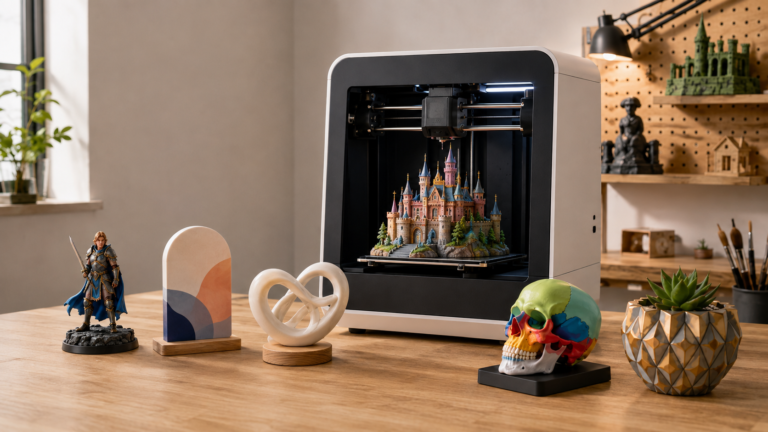
Desktop fabrication keeps moving toward the same promise: fewer steps between a digital idea and a finished product.
Laser machines moved cutting and engraving onto small workbenches. Desktop UV printers made full-color surface decoration more accessible. Resin and filament 3D printers made custom shapes easier to produce without molds.
HeyGears is positioning its G1 Series as a desktop full-color 3D and UV printing system. The company’s store page describes the series as combining full-color 3D build, 3D texture, and 2D printing in one machine, with official claims around full-color output, transparent and full-color resin combinations, and faster UV printing.
That’s the industry signal. But small shops shouldn’t stop at the headline.
The better question isn’t “Is this new machine exciting?”
The better question is: if full-color 3D plus UV-style output becomes easier to access, what products actually make sense for a maker business?
Because a machine can be technically interesting and still be a weak fit for your product table, pricing, deadlines, materials, customer expectations, or finishing workflow.
This article isn’t a hands-on HeyGears G1 Series review. It’s a business-fit look at the product categories this kind of hybrid workflow may open up, where the opportunity is real, and where ordinary 3D printing plus finishing may still be the smarter path.
Why This Signal Matters for Small Product Businesses
Most small maker shops already understand one side of the problem.
A standard 3D printer can make shapes, but color and finish often become separate work:
- sanding
- priming
- painting
- sealing
- airbrushing
- decal work
- resin coating
- assembly
- packaging after cure time
A UV printer can add full-color graphics to flat or semi-flat items, but it usually depends on blanks, fixtures, flatbeds, adhesion testing, material limitations, and surface prep.
A machine positioned around full-color 3D and UV output is interesting because it points toward a more finished-looking part coming out of a desktop workflow.
If that becomes reliable and affordable enough, it could change what small shops can test quickly.
Instead of printing a blank shape and then decorating it later, a seller may be able to move closer to:
- full-color character pieces
- textured display objects
- detailed branded prototypes
- event keepsakes
- custom miniatures
- decorative desk products
- medical, educational, or training models
- limited-run collectibles
That doesn’t mean every small shop should rush toward the category. It means the product-planning question deserves attention.
Don’t Treat This as a Replacement for Every 3D or UV Workflow
Hybrid machines are tempting because they sound like shortcuts: one machine, more capabilities, less finishing, and more product categories.
The operator version is more cautious. Before a shop treats a desktop full-color 3D + UV system as a production asset, it has to verify the boring details:
- machine cost and consumable cost
- supported materials
- real usable build size
- color durability
- texture quality
- print time
- cleaning workflow
- maintenance burden
- failed-print rate
- replacement parts and support
- file-prep difficulty
- software dependence
- whether the finish looks good enough for paid products
- whether customers will pay enough to justify the workflow
That’s the same reason Laticy’s guide to what machine you should buy first for a side hustle focuses on fit, not hype.
A machine isn’t a business by itself. It’s only useful if it helps you make sellable products at a margin you can repeat.
Product Category 1: Collectible Figures, Minis, and Character-Style Display Pieces
The most obvious fit for full-color 3D output is small display objects.
Think:
- tabletop minis
- collectible figures
- mascot-style characters
- gamer desk figures
- fantasy or sci-fi props
- small decorative statues
- creator merch figures
- fan-community-inspired original characters
This is where color matters because buyers aren’t just purchasing a shape. They’re purchasing personality, finish, and visual detail.
For a small shop, the opportunity isn’t necessarily mass-producing generic figures. That market can become crowded quickly.
The better angle is niche, original, and limited-run:
- original mascot collectibles for a creator brand
- event-specific character keepsakes
- custom tabletop accessories
- small-batch seasonal figures
- local-business mascot pieces
- original fantasy, horror, or gaming-inspired decor that doesn’t copy protected franchises
The warning is important: character products carry IP risk fast. A full-color machine doesn’t make it safe to sell lookalike characters, sports mascots, studio-style figures, or “close enough” versions of protected properties.
If this category is the plan, the design process needs to stay original, and the product listing language needs to avoid implying a connection the shop doesn’t have.
Product Category 2: Premium Prototypes and Client Concept Models
For client work, full-color 3D output may be more valuable as a presentation tool than as a consumer product machine.
A small shop could use it to create:
- product concept models
- packaging mockups
- architectural details
- signage prototypes
- trade-show display pieces
- branded desk samples
- investor-presentation props
- product-design test pieces
This can be stronger than selling small novelty items because the buyer isn’t only paying for plastic, resin, color, or print time. They’re paying for communication and a physical proof of an idea.
That can support higher pricing if the shop has the design skill and proofing process to back it up.
The catch is that client prototypes come with expectations. A rough test print isn’t the same as a polished presentation model. If the machine’s finish, texture, color fidelity, or dimensional accuracy isn’t good enough for the client’s use case, the project can turn into unpaid troubleshooting.
This is a category to test carefully with sample pieces before promising it publicly.
Product Category 3: Branded Desk Goods and Small Business Merchandise
Small businesses often want branded products that feel more interesting than another flat sticker or basic tumbler.
A full-color 3D + UV-style workflow may fit products such as:
- custom logo desk plaques
- small countertop display pieces
- branded QR-code holders
- mascot paperweights
- appointment-card holders
- premium nameplate accents
- event check-in desk props
- product-display risers with brand color
These are practical because the buyer has a business reason to purchase them. A dentist, bakery, realtor, photographer, salon, gym, or local vendor may not need 500 units. They may need a few pieces that make their table, desk, booth, or checkout area look more polished.
That’s a better small-shop fit than trying to compete with mass-produced promotional products.
The product has to solve a display or branding problem, not just show off that the machine can print in color.
Product Category 4: Wedding, Party, and Event Keepsakes
Event personalization is another possible fit because customers already pay for items tied to a specific date, theme, person, or memory.
Full-color 3D and UV-style output may support:
- cake topper accents
- table-number decor
- custom favor pieces
- miniature venue models
- guestbook display pieces
- branded event desk signs
- awards or recognition objects
- corporate event keepsakes
- themed party centerpieces
The business case depends on timing and repeatability.
Events have hard deadlines. If a workflow is slow, fragile, messy, or failure-prone, it can become dangerous for rush orders. Laticy has already covered why rush orders for custom products need discipline. A new machine doesn’t remove that pressure.
For event products, the smarter path is to start with controlled SKUs:
- fixed size
- limited color options
- clear proofing rules
- no open-ended custom sculpting
- enough production time built into the order window
Don’t offer “anything you can imagine” unless you actually want every order to become a custom design job.
Product Category 5: Educational, Training, and Medical-Style Models
HeyGears’ own materials reference specialized models such as displays and teaching aids. That points to a serious category: physical models used to explain something.
For a small shop, this may include:
- anatomy teaching models
- product cutaway-style samples
- classroom science models
- museum or exhibit pieces
- safety-training props
- repair-training models
- sales demonstration pieces
- process-explanation models
This category can be valuable because color and texture help people understand the object faster.
But it also requires more responsibility. If a model is used for education, training, medical communication, or safety explanation, accuracy matters. A decorative approximation may be fine for display; it may not be fine for instruction.
Small shops should avoid implying professional, medical, safety, or technical accuracy unless they’ve the source files, approvals, and expertise to support that claim.
Product Category 6: Premium Decor Accents and Shelf Objects
There’s also a home decor angle, but it needs taste control.
Full-color 3D printing can easily drift into novelty clutter. That isn’t where small shops usually build durable margins.
Better decor use cases may include:
- small sculptural shelf accents
- custom pet memorial pieces
- fantasy or nature-inspired decor
- layered-looking objects without hand assembly
- personalized room signs with raised color details
- seasonal display pieces
- custom ornament prototypes
This connects naturally to Laticy’s recent article on turning 2026 home decor trends into products makers can actually build. Trend fit still matters. A new production method doesn’t save a product that no one wants on a shelf.
For decor, the product has to feel intentional, not like a test print.
When Ordinary 3D Printing Plus Finishing May Still Be Better
A full-color 3D + UV workflow sounds efficient, but it won’t automatically beat ordinary 3D printing plus finishing.
Traditional printing and finishing may still be better when:
- the product only needs one or two colors
- the buyer values material feel more than printed detail
- sanding and painting create a more premium look
- the item needs durability more than visual complexity
- the design is large and the hybrid machine’s build area is limiting
- the final object needs a specific coating, texture, or outdoor finish
- the shop already has a proven production workflow
- labor is predictable and pricing already works
This is especially true for products like functional brackets, plain display stands, simple signage bases, fixtures, jigs, and parts that customers don’t buy for full-color visual detail.
A more advanced machine isn’t always the more profitable machine.
Sometimes the winning workflow is a basic printer, good design files, smart finishing, strong photos, and clean pricing.
The Pricing Question: Can Customers Pay for the Added Capability?
This is where a lot of machine excitement breaks down.
Full-color output may look better, but better-looking doesn’t automatically mean better margins.
Before buying into this product category, sellers should estimate:
- machine payment or depreciation
- resin, ink, support, cleaning fluid, or other consumables
- failed print allowance
- design time
- file prep
- washing, curing, cleaning, or post-processing
- packaging
- photography
- customer proofing
- replacement or remake risk
- shipping protection
Then compare the result against what buyers will actually pay.
If a product takes premium-machine time but sells like a novelty trinket, the math probably doesn’t work.
Use a pricing tool like Laticy’s Product Pricing Calculator before treating the machine as a business shortcut.
What Small Shops Should Verify Before Building Products Around It
Before committing to a product line around the HeyGears G1 Series or any similar full-color 3D + UV printer, verify the production details first:
- What is the true delivered cost of the machine and starter consumables?
- What are the ongoing consumable costs?
- What materials are supported?
- How large are the objects you can realistically make?
- How long does a sellable-quality print take?
- What does the cleaning process look like?
- How durable is the color under handling, light, abrasion, and packaging?
- How consistent is the output across repeat orders?
- How difficult is file preparation?
- What happens when a print fails?
- How fast is support if the machine goes down?
- Are replacement consumables easy to source?
Those aren’t negative questions. They’re business questions. A shop that answers them early can test intelligently. A shop that ignores them may end up with an expensive machine and no profitable product system.
A Safer Testing Path for Sellers
If this category interests you, don’t start with a huge product line.
Start with a small test set:
- One decorative product
- One branded/business product
- One event or keepsake product
- One prototype/client sample
For each one, track:
- design time
- print time
- failure rate
- consumable cost
- cleanup time
- photo quality
- packaging needs
- customer response
- final selling price
Then compare the products against your existing workflows.
If the full-color 3D + UV process creates a product that looks meaningfully better, sells for more, and doesn’t damage your production time, it may be worth developing. If it only creates more complicated versions of products you could already make, stay cautious.
Bottom Line: The Opportunity Is Product-Specific, Not Machine-Specific
The HeyGears G1 Series is a useful signal that desktop fabrication is moving toward more finished-looking, full-color, multi-process output.
That matters for small product businesses.
But the product opportunity isn’t “buy a full-color 3D + UV printer and sell whatever comes out.”
The opportunity is narrower and more practical:
- original minis and display pieces
- branded desk goods
- event keepsakes
- premium prototypes
- educational models
- intentional decor accents
Even then, the workflow has to pass the same business test as any other machine: can you make products people want, at a quality they’ll pay for, with costs and timelines you can control?
If yes, this category is worth watching closely.
If not, ordinary 3D printing, UV printing, laser work, CNC work, or hand finishing may still be the better business move.
The machine is the signal. The product system is what matters.
FAQ
What Is the HeyGears G1 Series?
HeyGears is positioning the G1 Series as a desktop full-color 3D and UV printing system. Its store page describes a workflow that combines full-color 3D build, 3D texture, and 2D printing in one machine. Sellers should verify current specifications, pricing, materials, and availability directly before making buying decisions.
Is This a Hands-On HeyGears G1 Series Review?
No. This isn’t a hands-on review. It’s a small-business product-opportunity analysis based on official positioning, current product signals, and cautious workflow planning.
What Products Make the Most Sense for Full-Color 3D + UV Printing?
The strongest fits are likely products where shape, color, and detail all matter: original minis, collectibles, branded desk goods, event keepsakes, premium prototypes, educational models, and intentional decor accents.
Can This Replace Ordinary 3D Printing and Painting?
Not automatically. Ordinary 3D printing plus finishing may still be better for larger objects, simple-color products, premium hand-finished work, functional parts, or products where durability and material feel matter more than full-color output.
Should a Small Shop Buy a Full-Color 3D UV Printer First?
Usually not without testing the business case. Start by comparing product demand, consumable cost, print time, cleanup, failure rate, and realistic selling price. A machine is only worth it if it helps create repeatable products at a margin that works.