
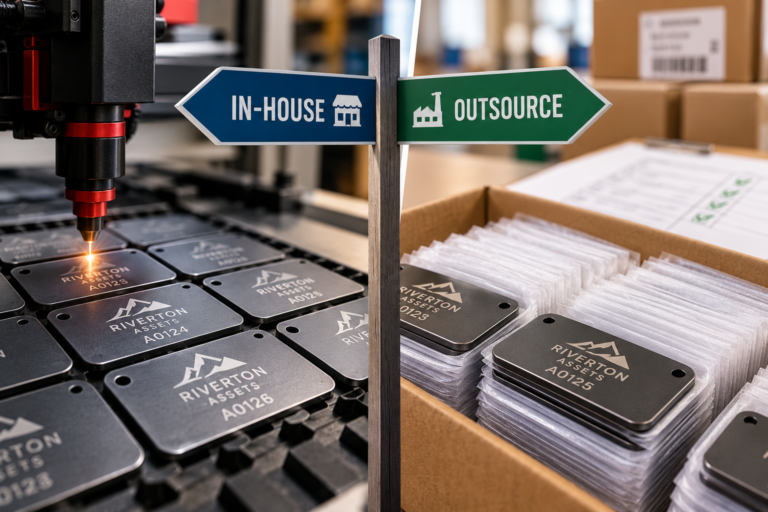
A large order can look like proof that your laser shop needs more equipment. It may only prove that one job is larger than the capacity you can safely promise this month.
The useful question isn’t “Are suppliers cheaper?” or “Could another laser run faster?” It’s whether your shop should make one defined order with the people, equipment, materials, approvals, and time you actually have. The alternative is placing that order with an outside producer under terms you can verify.
To make that concrete, this guide uses an illustrative job: 300 anodized aluminum asset tags, each carrying the same customer logo and a unique asset ID from a customer-provided file, packed in sequence for one required delivery date. The quantity, material, and workflow are just examples. They aren’t a quote, a production standard, or a recommendation for laser settings.
Freeze the job before comparing the two paths
An internal estimate isn’t useful if it describes a different job, and neither is a supplier quote. Create one comparison brief and issue the same revision to everyone involved.
For the illustrative tag order, define the blank manufacturer and product reference if already selected, finished dimensions, finish and color, engraving area, artwork revision, number of variable records, sequence rules, acceptable appearance, packaging order, destination, required arrival date, and who supplies the blanks. State whether substitutions require written approval.
Include the actual deliverables. Does “300 tags” mean 300 acceptable finished tags, or 300 blanks sent into production? Must the shop return unused customer-supplied stock? Are individual bags, labels, or a sequence report required? Is shipping included? Those details change both the cost and the risk, and they’re easy to miss.
Freeze the customer approval state too. “Logo attached” isn’t the same as approved production artwork. Identify who can approve the proof, the latest time approval can arrive without moving the delivery commitment, and what happens after a data or artwork revision. If you compare bulk options before these decisions are settled, you’re really comparing assumptions.
Build an honest in-house total
Start with what it’ll cost, in money and capacity, to make this exact job on your current setup. Don’t compare a supplier’s invoice against just your blank cost and estimated laser time.
The in-house side should include the approved blanks plus inbound freight, test pieces, expected process spoilage, artwork and variable-data preparation, proof creation, machine setup, active operator work, required supervision, inspection, sorting, packaging, and outbound delivery. Include cleanup, consumables, and any job-specific fixture or handling materials. Where you have your own process records, use them. They’re better evidence than a throughput claim you found online.
Laticy’s guide to pricing laser engraving custom work provides context for setup, design time, revisions, machine time, materials, and overhead. This decision adds another question. What work has to move, wait, or get turned down while the bulk job ties up the shop?
Measure capacity in usable windows
Calendar hours aren’t automatically production capacity. Map the job into windows during which a trained operator, approved machine configuration, extraction or ventilation, material, and inspection resources are all available. Follow the equipment and material manufacturers’ instructions and your shop’s procedures. Don’t assume a repetitive order can run unsupervised.
Use a small validated batch or a comparable completed run to estimate hands-on labor, machine occupancy, inspection, and packing. If there’s no comparable process, label the estimate uncertain and leave time for qualification. This article doesn’t supply universal settings or a production rate for anodized aluminum.
Then place those windows on the actual schedule. Protect already promised work, maintenance, normal operating limits, and a documented allowance for plausible rework. The rush-orders guide is useful if the requested date would force queue changes, but outsourcing won’t turn an impossible rush promise into a possible one. The customer deadline still depends on approval, production, transit, and inspection.
Keep opportunity cost visible but separate
A bulk job may displace smaller orders. Record the specific work affected and the contribution it would have produced, rather than adding a vague “lost sales” number. Don’t count the same consequence twice, once as labor cost and again as lost margin.
Opportunity cost can matter even when the in-house cash outlay looks lower. It’s also uncertain. Show it as a separate decision line with its basis so nobody mistakes it for a supplier charge or guaranteed revenue.
Ask suppliers for comparable evidence, not one number
Send the frozen brief to candidate suppliers and request a written response against every important field. A low total without scope, dates, and remake terms isn’t a comparable quote yet.
Ask each supplier to identify:
- the exact blank or permitted material specification, and whether substitution requires approval;
- setup, sample, unit, variable-data, sorting, packaging, freight, tax, and other charges;
- the quote’s quantity basis, validity period, payment terms, and what can change the price;
- the date by which files, blanks, payment, and sample approval must be complete;
- the stated production window, ship method, ship-from location, and promised ship date;
- the inspection standard, acceptable quantity, overrun or underrun policy, and reporting method;
- who owns replacement blanks, production labor, freight, and schedule recovery after an error;
- which subcontractors or facilities may receive the artwork or customer data; and
- how files, production copies, and backups are protected, retained, returned, or deleted.
Treat these as questions, not evidence that a supplier is qualified. A professional-looking quote doesn’t prove process capability, security, or delivery performance. Verify the evidence appropriate to the order and your obligations.
Convert every quote to landed, accepted-order cost
Normalize quotes in a table, including every relevant logistics handoff. Don’t erase real differences by forcing unlike terms into one unit price.
| Comparison line | In-house path | Outside path |
|---|---|---|
| Scope basis | Same approved brief and finished acceptable quantity | Same approved brief and finished acceptable quantity |
| Materials | Blanks, inbound freight, tests, planned spoilage | Included exact blanks or your supplied blanks, plus inbound/outbound freight |
| Preparation | Artwork, data cleanup, proof, setup | Setup, file/data preparation, sample charges |
| Production | Active labor, supervised machine occupancy, consumables | Batch and variable-record charges |
| Quality | First-piece approval, inspection, sorting, records | Sample approval, supplier inspection evidence, your incoming inspection |
| Fulfillment | Sequence packing and delivery | Sorting, packaging, freight, duties or taxes where applicable |
| Failure exposure | Internal remake materials, time, and displaced work | Your uncovered losses plus responsibilities stated in supplier terms |
| Schedule | Approved internal windows and buffer | File/sample gates, stated production, transit, incoming inspection, recovery time |
| Data handling | Internal access, storage, retention, deletion | Transfer method, access, subprocessors, retention, return/deletion |
| Opportunity effect | Named work displaced by the order | Internal coordination and receiving work; capacity released for named work |
The resulting outside total is the amount required to receive an inspected, acceptable order at the needed location. It’s not just unit price multiplied by quantity. Keep recoverable taxes, speculative failure costs, and opportunity estimates labeled rather than blending them into an apparently precise figure.
Put a sample approval gate before the batch
For a new supplier, material, artwork treatment, or variable-data workflow, request a representative preproduction sample or documented first-article process before authorizing the full run. The sample should exercise the decisions that could fail, not just display the easiest logo in the file.
For the illustrative job, that could mean checking the stated blank, logo placement, legibility, contrast, surface condition, correct mapping of several test asset IDs, orientation, and required packaging sequence. Use the approved customer specification and authorized reference artwork. Don’t invent a visual tolerance after you’ve seen the sample.
Record the sample identity, quote and brief revision, material reference, artwork/data revision, date, reviewer, decision, and approved exceptions. Approval should only release the scope the sample represents. It shouldn’t waive errors elsewhere in the dataset or silently approve a substitute material.
Build the sample cycle into the schedule. Ask when the sample will be produced, how it will be delivered or documented, how quickly the customer can review it, and whether the production slot is reserved before or after approval. “Lead time after approval” doesn’t mean much unless everyone agrees on what approval means and when the clock starts.
Assign spoilage and remake responsibility in writing
Every path needs a plan for wrong artwork, defective blanks, engraving defects, duplicate or skipped IDs, packing errors, transit damage, and late discovery. The important question isn’t only who caused a problem. It’s who will inspect, notify, provide replacement stock, perform the remake, pay each freight leg, and protect the delivery date.
If you supply the blanks, document the quantity sent, condition evidence, allowed test or spoilage quantity, ownership of unused pieces, and treatment of supplier-damaged stock. If the supplier provides blanks, state whether the quote promises the specified product or merely a general material description.
Separate customer changes from supplier errors and from your own file-preparation errors. A customer-approved typo, a corrupted variable-data import, and a supplier engraving defect are different events. The quote and purchase terms should say how each is handled so you aren’t relying on a phone call once the deadline is already at risk.
Ask for the supplier’s remake notification window and evidence requirements. Make sure your incoming inspection can happen within that window. A remake promise that expires before you can reasonably inspect the shipment won’t protect your schedule much.
Treat customer files as controlled order material
The asset-ID file in the illustrative job may reveal internal identifiers or other customer information. Before sending it outside, confirm that the customer has authorized the proposed use and that your agreement permits the transfer. Share only what the supplier needs.
Ask how files are transferred, who can access them, where they are processed or stored, whether subcontractors or cloud services receive them, and how long working files, production records, and backups are retained. Ask how deletion or return is confirmed, what happens after termination, and how a security incident is reported. If contractual, legal, or customer requirements apply, have the appropriate qualified reviewer assess the terms.
Use unique order and revision identifiers. Avoid email chains full of ambiguously named spreadsheets. Preserve the approved source separately, transmit through the agreed method, and verify record count, uniqueness, and mapping before release. After delivery, retain only what your documented obligations require; don’t promise deletion that your actual systems or the supplier’s backups can’t deliver.
Confidentiality language isn’t proof of technical security, and this guide doesn’t certify any supplier. If you can’t get the answers or agreement you need, treat that as a decision input. It’s not an invitation to send the file and hope.
Compare schedule exposure, not headline lead time
Supplier lead-time evidence should describe this order’s gates, clock start, production window, and ship obligation. Draw both paths from the same starting point to the required arrival date.
The in-house path may include final file approval, blank receipt, process confirmation, first-piece approval, batch windows, in-process checks, sorting, packing, and delivery. The outside path may include supplier onboarding, file transfer, quote acceptance, payment, blank availability, sample production, sample transit or review, customer approval, production queue, freight, incoming inspection, and possible recovery.
For each gate, name the owner, evidence required to pass, earliest realistic completion, and consequence of delay. Ask a supplier for dated commitments or documented service terms relevant to this quote. A general website estimate or sales statement is weaker evidence than a quote that identifies the scope, clock start, production window, and ship obligation. Even a promised ship date isn’t an arrival guarantee.
Test plausible disruptions: sample rejection, late customer approval, a short shipment, a carrier delay, or a failed incoming inspection. Don’t assume every disruption will happen, and don’t pretend a buffer guarantees delivery. The exercise shows which path has time you can recover, and who can act while there’s still time to do it.
Make the decision for this order
Use a decision sheet with four sections: scope match, total economic effect, control evidence, and schedule resilience. Mark unknowns openly. Don’t bury them.
First, disqualify any path that cannot meet a mandatory requirement: approved material, data restriction, inspection need, accountable remake term, or realistic arrival date. A cheaper route that fails a requirement isn’t the winning quote.
Second, compare the normalized totals and their confidence. Keep cash charges, internal labor, machine occupancy, expected spoilage, opportunity effects, and downside exposure visible. Don’t manufacture a universal savings percentage. Your conclusion should trace back to the defined order and the schedule you’ve actually got.
Third, record the evidence behind control claims. An existing validated in-house process may carry less technical uncertainty but more capacity pressure. A supplier may free machine time but add sample, transit, incoming-inspection, and contractual dependencies. Neither route is automatically safer or better.
Finally, write the decision and triggers for reconsideration. For example: produce this order in-house because the approved process fits protected capacity; outsource this order after sample approval because the internal schedule cannot absorb it; split only if sequence control, appearance consistency, responsibility, and customer approval support a split; or decline/revise the promise because neither route has a defensible schedule.
Don’t let one order turn automatically into a case for buying equipment. If repeated, profitable demand survives this analysis and the current constraint is truly equipment capacity, then evaluate expansion separately. Laticy’s machine-deal buyer filter helps test fit, support, full installed cost, workflow, and payback before a discount drives that choice. The defined job doesn’t call for a new-machine recommendation.
The best route is the one that can deliver the approved order under documented terms with acceptable cost and recoverable risk. It isn’t the one with the most attractive hourly rate or the newest equipment.
FAQ
When should a small laser shop outsource a bulk engraving order?
Consider outsourcing when a defined order exceeds protected internal capacity and a supplier can provide acceptable evidence for scope, sample approval, timing, quality, remake responsibility, and file handling. Quantity alone doesn’t justify outsourcing, and a quote doesn’t prove the supplier meets those requirements.
Should I send the whole customer file to get a quote?
Not by default. Provide enough information to describe the work, but minimize customer data during quoting. Before transferring production data, confirm authorization, contractual requirements, transfer method, access, subcontractors, retention, deletion, and incident terms. Where a representative, non-sensitive sample can support quoting, use it instead of the live dataset.
Is splitting the order between my shop and a supplier safer?
Not automatically. A split can add material, appearance, sequencing, inspection, packaging, and responsibility mismatches. It’s only worth it when both paths can meet the same approved specification and the customer accepts any relevant difference. Assign ranges and remake ownership clearly, and compare the split schedule as its own option.
Does outsourcing mean I don’t need schedule buffer?
No. It changes where the uncertainty comes from. It doesn’t remove it. Sample approval, supplier queue, freight, incoming inspection, and remake time need explicit treatment. Keep a realistic recovery allowance based on the evidence you’ve got for this order. Just don’t present it as a delivery guarantee.