
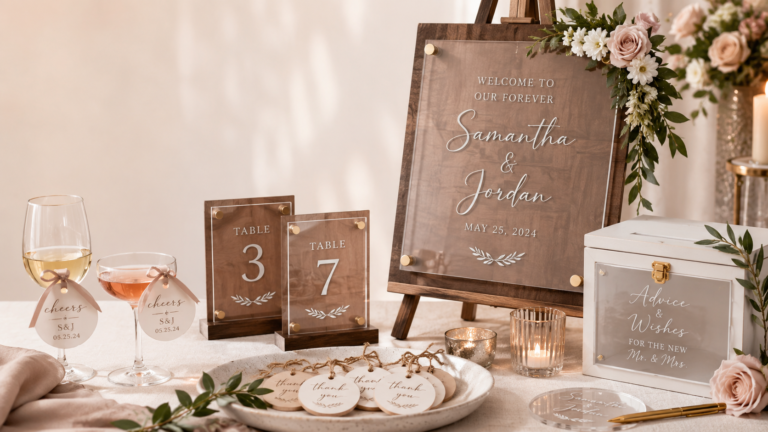
Wedding and event personalization always looks easier from the outside.
A couple wants custom signage. A planner wants matching table markers. A business wants branded keepsakes. A family wants favors that feel more personal than bulk party supplies.
For a maker, that sounds like a good lane. The buyer already has a reason to purchase, the deadline is real, and personalization can support higher prices.
But event work can also bury a small shop in messages, revisions, rush requests, and tiny custom details that don’t pay for themselves.
That’s why trend interest matters, but the workflow matters more.
Pinterest-style wedding and event trend signals are useful because they point toward individuality, personalization, layered visuals, keepsake details, and more expressive event styling. But a small shop shouldn’t translate that as “offer unlimited custom work.”
The better translation is this:
Build event products that feel personal while still being repeatable enough to price, proof, make, pack, and deliver without chaos.
That’s the difference between a profitable event-personalization offer and a custom-order trap.
The real opportunity is specific personalization, not unlimited personalization
Personalization sells because events are emotional. Names, dates, venues, table numbers, family roles, inside phrases, company logos, and guest experiences all matter more when there’s a one-time occasion attached.
The mistake is letting every customer define the entire product from scratch.
A stronger event offer has boundaries:
- a clear product type
- a small number of material choices
- a defined size range
- a limited set of customization fields
- a proofing process
- a deadline policy
- a revision limit
- packaging that protects the order
That might sound less creative, but it’s usually better for both sides. The buyer gets confidence. You get a product you can actually deliver.
For example, “custom wedding signs” is too broad. “A layered acrylic-and-wood welcome sign with couple names, date, and venue line” is clearer.
“Event favors” is too broad. “Personalized acrylic drink tags with guest names and one font choice” is clearer.
The more specific the offer, the easier it is to photograph, price, explain, and repeat.
Product lane 1: welcome signs and entry pieces
Welcome signs are one of the easiest event products for buyers to understand. They’re visible, emotional, and useful in photos.
They also fit several maker workflows:
- laser-cut acrylic lettering on wood or painted backers
- engraved wood welcome boards
- UV printed acrylic or foam-board-style panels
- CNC-carved wood signs for rustic or higher-end venues
- layered mixed-material signs with removable event details
The product risk is size and shipping. Large signs can look impressive, but they create packaging, damage, storage, and delivery problems. If you’re not set up for large-format work, start with smaller entry signs, tabletop welcome signs, or modular signs that fit your actual production and packaging limits.
A good entry-piece offer should define:
- finished size
- material options
- whether stands or mounting are included
- indoor/outdoor limitations
- proofing timeline
- production timeline
- packaging and local pickup/shipping rules
Don’t leave those details to messages after the customer orders. Event buyers are often already stressed. A clear listing or quote page reduces friction.
Product lane 2: table numbers, place cards, and seating details
Table products are often better than large signs for small shops because they’re repeatable.
A wedding may need 10 to 25 table numbers. A corporate dinner may need branded table markers. A shower or birthday event may need place cards, food labels, favor tags, or drink markers.
These are useful because one design can become a set.
Examples include:
- acrylic table numbers
- engraved wood table numbers
- UV printed menu cards or table cards
- place names in acrylic, wood, or leatherette
- drink tags with guest names
- food station signs
- dessert table markers
- reserved seating signs
- memorial table signs
The business advantage is that the customer usually needs multiples, not one isolated piece. That can make the order more worthwhile if your setup process is controlled.
The risk is data handling. Guest names, seating lists, table names, and spelling variations can create errors fast.
For any product involving names or lists, require clean customer input. Don’t accept scattered text messages, screenshots, or partial lists if the job has many names. Use a form, spreadsheet, or copy-paste template so the customer confirms exact spelling before production.
A pretty product with one misspelled guest name can turn into a costly remake.
Product lane 3: favors people might actually keep
Wedding and event favors are tricky.
Buyers like the idea of personalization, but many favors become clutter. That doesn’t mean makers should avoid them. It means the product needs a reason to survive the ride home.
Better favor ideas usually have at least one of these qualities:
- useful after the event
- small enough to pack easily
- tied to the event without being too event-specific
- attractive enough to keep out
- affordable enough for quantity orders
- easy to personalize in batches
Examples:
- engraved bottle openers
- acrylic or wood bookmarks
- reusable gift tags
- mini ornaments that are not overly seasonal
- coasters
- keychains with restrained design
- small photo-frame magnets
- bag tags
- desk or shelf mini keepsakes
- recipe cards or drink cards for showers and family events
The biggest favor mistake is over-personalizing the item with the couple’s names so strongly that guests have no reason to keep it.
A coaster with the couple’s full names and date may matter to the couple. A coaster with a subtle venue illustration, initials, or useful design may have a better chance of staying in someone’s home.
That’s the buyer conversation to have. The product should make the event feel considered, but it shouldn’t become disposable branded clutter.
Product lane 4: guest books and memory pieces
Guest books are a good fit for personalization because they’re meant to become keepsakes.
Small shops can approach this several ways:
- engraved wood guest book covers
- acrylic guest book signs
- drop-box guest books with shaped pieces
- photo guest book accessories
- advice-card boxes
- memory boxes with engraved plates
- signature boards
- anniversary capsule boxes
This lane works best when the product has a clear post-event purpose. Where will it go after the wedding, shower, graduation, memorial, or company celebration?
If the answer is “into storage forever,” the design may need work.
Memory pieces can justify higher prices when the finish, packaging, and proofing feel careful. They also need conservative claims. Don’t imply heirloom durability unless the materials and construction justify it. It’s enough to say the product is designed as a keepsake.
Product lane 5: corporate and organization event personalization
Don’t limit event personalization to weddings.
Corporate events, schools, nonprofits, churches, teams, clubs, conferences, retreats, awards nights, real estate events, and local business launches can all need personalized products.
This lane often has less emotional design pressure than weddings and more repeat potential.
Examples include:
- branded table signs
- name badges
- sponsor plaques
- acrylic awards
- speaker gifts
- donor recognition pieces
- QR code table cards
- staff appreciation gifts
- event check-in signage
- VIP tags or passes
- branded keepsake boxes
For B2B event work, clarity and reliability matter more than trendiness. The buyer wants the order to arrive correct, branded properly, and on time.
That means the offer should include file requirements, logo-quality rules, proof approval, production cutoff dates, and reorder options.
If you can make the same product again for next year’s event, that’s a stronger business lane than a one-time overly custom design.
Match the product to the machine, not the other way around
Event work can be done with laser engraving, CNC routing, UV printing, sublimation, 3D printing, or mixed materials. The machine should serve the product, not become the pitch.
Laser shops are strong for acrylic, wood, leatherette, tags, layered signs, table markers, and engraving details.
UV printing works well for full-color flat items, acrylic pieces, signage, cards, branded goods, and short-run visual consistency.
CNC can work for premium wood signs, trays, plaques, guest book alternatives, and venue-style pieces where depth and finish matter.
3D printing can support custom display pieces, themed accents, cake topper concepts, prototypes, and specialty event props, but it needs strong finishing if the product will be handled up close.
Mixed-material products often feel more premium than single-process products, but they also increase assembly time. Don’t add layers, hardware, paint, resin, vinyl, or printed inserts unless the price supports the labor.
If you are still choosing which tool fits your product lane, start with the broader machine-fit thinking in CO2 vs fiber vs diode laser for small business or the premium personalization discussion around laser products that can command higher prices. The event offer should come before the machine shopping.
Build proofing rules before you sell event products
Proofing is where event personalization either becomes professional or becomes a mess.
Every event product should have a proofing policy before it goes live.
Decide:
- whether a digital proof is included
- how many revisions are included
- what counts as a revision
- how long the customer has to approve
- what happens if approval is delayed
- whether spelling is customer responsibility after proof approval
- what changes are not allowed after approval
- whether rush proofing costs extra
This may feel formal, but it protects the order.
Event buyers often have moving pieces: planners, partners, venues, family members, sponsors, bosses, and committees. Without proofing boundaries, one product can become a group-editing project.
That doesn’t mean being cold. It means making the process clear before money and deadlines are involved.
The same logic applies to rush work. If an event buyer asks for a fast turnaround, don’t say yes just because the job is exciting. Use a real rush-order policy. The guide on rush orders for custom products is directly relevant here.
Price event products for the whole job, not just the material
Event products are easy to underprice because the physical item can look simple.
Acrylic table numbers may not use much material. Drink tags may be small. Place cards may cut quickly. A sign may only use one sheet of acrylic or one wood panel.
That’s not the full cost.
Event personalization can include:
- customer messaging
- design setup
- name/list cleanup
- proofing
- revisions
- material waste
- test cuts or test prints
- batch setup
- finishing
- assembly
- packaging
- deadline pressure
- local pickup coordination
- shipping risk
If you only charge for material and machine time, the order may look profitable while quietly eating your week.
Quote the job around the full workflow.
For personalized sets, minimum order quantities can help. A set of 10 table numbers, 50 drink tags, or 100 favor tags may make more sense than offering every item one at a time. If you do offer singles, price them high enough that the setup is still worth it.
Use the Product Pricing Calculator to sanity-check the math, and revisit custom laser work pricing if the job involves engraving, proofing, and custom setup.
Product photos should show the event context
Event buyers need to imagine the product in use.
A flat photo of a table number on a white background may show the product clearly, but it doesn’t always sell the event feeling. You usually need both:
- a clean product photo for detail
- a styled context photo for use
For example:
- a welcome sign near florals or an entry table
- table numbers placed with plates, napkins, or candles
- favor tags attached to packaging
- drink tags on glassware
- signage photographed at realistic viewing distance
- guest book pieces styled with pens, cards, or a display box
Don’t overstyle so much that buyers can’t tell what’s included. The goal is context, not confusion.
If your event products look weaker online than they do in person, fix the photo setup before changing the product line. The product photography setup guide covers that broader conversion issue.
A simple event-personalization offer stack
If you’re testing this lane, don’t launch twenty custom event products at once.
Entry product:
- small table sign
- favor tag
- drink tag
- place card
- food label
Mid-price product:
- table number set
- small welcome sign
- guest book sign
- personalized coaster set
- branded event card set
Higher-value product:
- layered welcome sign
- full table signage set
- memory box or guest book alternative
- corporate event recognition set
- coordinated favor and packaging bundle
That gives customers different price points without making your shop look scattered.
It also lets you learn which products create the best mix of interest, margin, and manageable production.
When to say no to event personalization
Some event jobs aren’t worth taking.
Say no or quote high when:
- the deadline is too close
- the customer has not finalized names or wording
- the order requires too many unknown materials
- the customer wants unlimited revisions
- the product must survive conditions you cannot verify
- shipping damage risk is too high
- the budget does not match the scope
- the buyer wants you to copy another maker’s exact design
- the order would disrupt better-paying work
A calendar deadline doesn’t make a bad order good. It only makes the consequences faster.
Strong event shops aren’t the ones that say yes to everything. They’re the ones that make the offer clear enough that the right buyers can say yes quickly.
The best event products feel personal and controlled
Wedding and event personalization can be a strong lane for small makers because the buyer already has a reason to care.
But the profitable version isn’t unlimited custom work.
It’s controlled personalization: clear products, clear choices, clear proofing, clear pricing, and clear timelines.
That still leaves room for beautiful, emotional, highly personal products. It just keeps the business from turning every order into a custom project management problem.
Pinterest-style trend signals can point you toward more expressive, personal, event-specific products. The maker-business job is to turn that signal into offers you can repeat.
That’s where the opportunity is.
Not “we can make anything.”
“We make this kind of event product really well, and here is exactly how the order works.”
FAQ
What personalized wedding products can makers sell?
Makers can sell welcome signs, table numbers, place cards, drink tags, favor tags, guest book alternatives, memory boxes, coasters, acrylic signs, engraved wood pieces, and coordinated signage sets. The strongest products are specific, easy to approve, and repeatable enough to make without losing margin.
Are wedding favors still worth making?
Wedding favors can be worth making if they’re useful, attractive, easy to personalize in batches, and not too event-specific for guests to keep. Coasters, bookmarks, bottle openers, reusable tags, small ornaments, and restrained keepsakes usually make more sense than clutter-heavy novelty favors.
What is the best machine for event personalization?
There’s no single best machine for every event product. Laser engravers are strong for acrylic, wood, leatherette, tags, and layered signage. UV printers work well for full-color flat items and branded goods. CNC routers fit premium wood signage and carved pieces. The right machine depends on the product, deadline, finish expectations, and pricing.
How should small shops price custom event products?
Small shops should price event products around the full job, not just material and machine time. Include design setup, customer messages, proofing, revisions, list cleanup, test pieces, finishing, packaging, deadlines, and shipping risk. Minimum order quantities can also help protect margin on batch work.
Should event products include proofs?
Most personalized event products should include a clear proofing process. The shop should define how many proofs or revisions are included, how long approval takes, what happens if approval is delayed, and who’s responsible for spelling after approval. Proofing rules protect both the customer and the maker.