
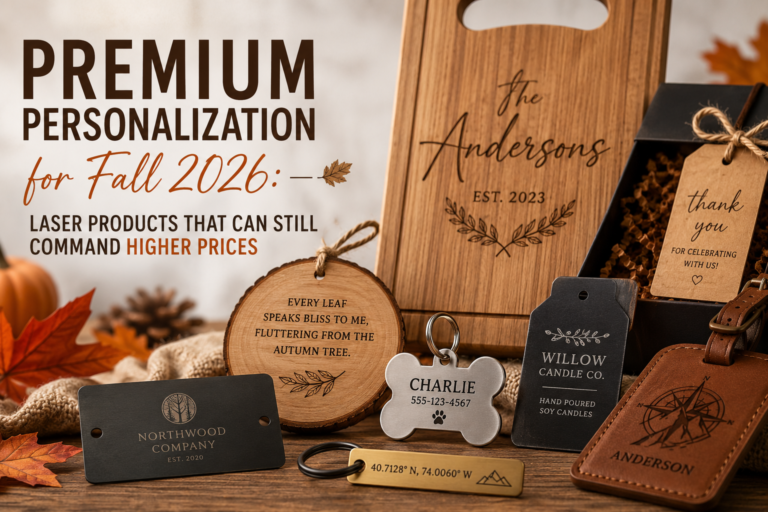
Fall is when a lot of maker businesses start thinking about volume. More ornaments. More tags. More signs. More gifts. More local event orders. More everything.
That can work, but volume is not the only way to grow a laser business. In some shops, chasing volume too early just creates a queue full of low-margin products, rushed proofs, fragile packaging, and customers who expect custom work to cost the same as a shelf item.
Premium personalization is the other side of the fall plan.
The goal is not to make everything expensive. The goal is to identify the products where personalization actually increases perceived value, where the buyer understands why the item costs more, and where your workflow can support the higher price without turning every order into a custom-service mess.
For fall 2026, the strongest premium laser products are usually not the most complicated ones. They are the ones that feel specific, giftable, durable, and easy to present.
What Makes a Laser Product Feel Premium?
A product does not become premium just because it is engraved.
A cheap keychain with a name on it is still usually a cheap keychain. A thin ornament with rushed artwork is still a thin ornament. A generic cutting board with a copied design may sell, but it may not deserve a premium price unless the material, finish, packaging, and buyer reason are strong enough.
Premium usually comes from a few things working together:
- better material choice.
- cleaner design restraint.
- personalization that feels meaningful, not random.
- a clear gifting or business use case.
- good proofing and order intake.
- strong photos that make the item feel worth the price.
- packaging that matches the promise.
- a price that reflects labor, risk, and replacement cost.
That matters because shoppers can compare engraved products quickly. If your product looks like every other name-on-a-blank listing, the buyer’s first question becomes price. If it looks like a thoughtful gift, event detail, professional add-on, or keepsake, the buyer has a better reason to pay more.
The difference is not hype. It is positioning and execution.
Start With Buyer Intent, Not Blank Catalogs
A common mistake is starting with the blank: wood rounds, metal tags, acrylic pieces, leather patches, slate coasters, bottle openers, ornaments, tumblers, jewelry blanks, and so on.
Blanks matter, but they are not the business strategy.
Before buying more inventory, ask why someone would pay extra for the finished product. Fall buyers usually fit into a few useful groups:
- Gift buyers who want something personal but not cheesy.
- Event planners who need a detail that feels custom and organized.
- Small businesses that want branded items in small batches.
- Pet owners who want practical personalization with better materials.
- Families who want keepsakes for holidays, milestones, or memorial moments.
- Local shoppers who want a finished, gift-ready item instead of a DIY-looking product.
Those buyers are not all looking for the same thing. A corporate client buying event tags does not care about the same emotional details as a parent buying a keepsake ornament. A pet owner may value durability and legibility more than decorative flourishes. A wedding client may care more about consistency, proofing, and deadlines than the engraving technique itself.
That is why premium personalization works best when the product has a clear buyer job.
Product Category 1: Metal Tags With a Real Use Case
Metal tags are one of the better premium personalization lanes because they can be useful, compact, durable, and easy to photograph.
That does not mean every metal tag is premium. A basic name tag sold as a novelty item may still be low-ticket. The stronger opportunities are tags tied to a specific use:
- pet ID tags with clean readable layouts.
- premium luggage tags or travel tags.
- branded product tags for handmade goods.
- event table markers or guest tags.
- memorial keepsake tags.
- equipment labels for small businesses.
- gift enclosure tags for premium packaging.
The key is to avoid making the buyer do all the imagination work. Skip the generic “custom engraved metal tag” listing and sell the use case instead: a readable pet tag, a polished product label, a branded event detail, or a keepsake that can be attached to a gift, bouquet, display, or packaging piece.
If you are using a fiber laser or a compact premium personalization machine, this is also where machine choice can matter. Laticy has already covered the difference between the xTool F1 and F2 Ultra for jewelry, metal tags, and premium personalization. That comparison is useful if you are deciding whether your current laser setup actually fits metal-tag work or whether you need a different class of machine before promising that product line.
If xTool is part of your buying shortlist, you can check current models and pricing here.
Do not build the product line around a machine name, though. Build it around the finished offer: readable, durable, giftable, and easy to reorder.
Product Category 2: Pet Gifts That Are Practical First
Pet products are tempting because they personalize well and photograph well. The risk is that many shops make the same generic “pet mom” or paw-print products, then compete mostly on price.
Premium pet personalization usually works better when it starts with a practical need:
- readable ID tags.
- memorial ornaments or plaques.
- leash hooks with the pet’s name.
- treat jar labels or lids.
- framed photo-and-name keepsakes.
- custom crate or kennel nameplates.
- small gift sets with tag, ornament, and card.
The premium angle is not “put the dog’s name on it.” It is durability, readability, material fit, and emotional usefulness.
For ID tags, legibility matters more than decorative clutter. For memorial items, restraint matters more than stuffing the design with clip art. For gift sets, packaging matters because the buyer may be sending it directly to someone else.
If you want this lane to command higher prices, show the finished product in context. A tag lying on a white table can work for a marketplace listing, but a tag attached to a collar, a keepsake paired with a small card, or a gift set placed in packaging makes the value easier to understand.
That is where product photography becomes part of the margin strategy, and not just a finishing step.
Product Category 3: Corporate and Event Add-Ons
Corporate and event work can support premium pricing because the buyer is often solving a deadline, presentation, or guest-experience problem.
Good examples include:
- engraved name badges for small teams.
- sponsor tags or branded table markers.
- small-batch client gifts.
- branded packaging pieces.
- QR code signs for booths or displays.
- VIP tags, drink markers, or place cards.
- engraved thank-you pieces for speakers, vendors, or staff.
The danger is underquoting because each item seems small.
A single event tag may not look expensive. But event work often includes intake, logo cleanup, proofing, revisions, batch organization, deadline pressure, packaging, and sometimes delivery coordination. If you price only the blank and machine time, you will usually undercharge.
For event personalization, premium pricing needs a clear process:
- minimum order quantity or setup fee.
- logo/file requirements.
- proof approval cutoff.
- revision limit.
- rush-order policy.
- replacement policy for customer-supplied errors.
- production timeline after final approval, not after the first message.
This is especially important in fall, when clients may be preparing holiday parties, markets, end-of-year gifts, school events, church events, local fundraisers, and corporate appreciation orders.
If you offer rush work, separate production rush from shipping speed. A customer paying for expedited shipping is not the same as a customer paying you to reorder your production queue.
Product Category 4: Premium Packaging Pieces
Packaging is easy to ignore because it feels secondary to the product. But for premium personalization, packaging can be the thing that makes the buyer believe the item is gift-ready.
Laser-friendly packaging pieces can include:
- engraved wood gift tags.
- branded hang tags.
- small acrylic care cards.
- product insert cards with QR codes.
- engraved box lids or labels.
- reusable ornament-style gift tags.
- leatherette patches or wraps.
- small nameplates for gift boxes.
These can work in two ways.
First, they can be products you sell directly to other small businesses. A candle maker, boutique, baker, florist, soap maker, photographer, or local gift shop may need small-batch branded packaging that looks better than printed stickers.
Second, they can increase the perceived value of your own products. A personalized ornament in a plain bag feels different from a personalized ornament boxed with a neat tag, care card, and simple ribbon.
The mistake is adding packaging cost without pricing for it. If upgraded packaging adds material cost, assembly time, storage complexity, and shipping weight, it needs to be reflected in the final price or offered as a paid upgrade.
This is where a pricing calculator is useful. Do not guess whether a premium packaging upgrade is profitable. Run the numbers with the blank, packaging, labor, fees, and profit margin included using Laticy’s product pricing calculator.
Product Category 5: Keepsakes With Restrained Design
Keepsakes can command higher prices because they are emotional purchases. They can also go wrong quickly when the design feels generic, overdecorated, or copied from every other listing.
Fall and Q4 keepsake opportunities include:
- first-home ornaments.
- family-name ornaments.
- baby’s first holiday pieces.
- memorial ornaments.
- handwriting or recipe engravings.
- school-year keepsakes.
- sports-team gifts.
- military, dispatcher, nurse, teacher, or first-responder appreciation gifts.
- small photo-display pieces.
- milestone date plaques.
For keepsakes, restraint usually sells better than clutter. The buyer is not paying for the most graphics. They are paying for the name, date, handwriting, memory, or relationship to feel handled carefully.
This is also where proofing matters. Names, dates, handwriting files, and memorial text carry a higher error risk than generic products. A mistake on a memorial item is not just a material loss; it damages trust.
Premium pricing should include the extra care required:
- clean intake form.
- exact spelling confirmation.
- file-quality instructions.
- proof approval before production.
- clear turnaround time.
- no unlimited revision loop.
If a product requires emotional accuracy, the workflow has to be stronger than a casual DM conversation.
Product Category 6: Jewelry-Adjacent Personalization
Jewelry-adjacent products can support higher prices, but they need honest positioning. A laser-engraved charm, tag, pendant, ring dish, jewelry card, or small keepsake is not automatically fine jewelry.
The better lane for many maker shops is practical premium personalization around jewelry and accessories:
- engraved jewelry tags.
- charm cards.
- small metal keepsake charms.
- ring dishes with initials or dates.
- necklace display cards for handmade jewelry sellers.
- branded tags for boutique products.
- limited-run event charms.
This lane works best when you understand the material, finish, and customer expectation. Metal engraving, coated blanks, stainless steel, aluminum, brass, acrylic, wood, and leatherette do not all behave the same. They also do not all communicate the same value.
If you are selling jewelry-adjacent personalization, be careful with wording. Do not imply precious-metal value, hypoallergenic properties, waterproof durability, or luxury quality unless you can support those claims for the actual material being sold.
Premium does not come from overclaiming. It comes from a finished offer that is specific, clean, and priced honestly.
How to Choose Which Premium Product to Test First
Do not test ten premium categories at once. That creates too many blanks, too many photos, too many proofing variables, and too many half-finished listings.
Pick one product lane and test it properly.
A useful filter:
- Can the buyer understand the product in three seconds?
- Does personalization make the item more valuable, not just more complicated?
- Can you produce it consistently without custom chaos?
- Can you photograph it in a way that supports the higher price?
- Can you ship it safely and affordably?
- Can you price it with labor, proofing, packaging, fees, and profit included?
- Can it become a repeatable offer, not a one-off favor?
If the answer is no, the product may still be fun, but it may not be the right premium fall offer.
For many shops, the best first test is one narrow product with three to five variations. For example:
- one pet tag style in three finishes.
- one event tag format with two size options.
- one keepsake ornament design with a clean personalization field.
- one branded packaging tag for small businesses.
- one premium gift set built around an existing product.
That gives you enough variety to test buyer response without creating a messy catalog.
Price the Workflow, Not Just the Object
Premium personalization fails when the shop charges for the item but gives away the workflow.
The workflow includes:
- messages.
- design setup.
- file cleanup.
- proofing.
- revision handling.
- material testing.
- machine setup.
- engraving time.
- finishing.
- packaging.
- photography.
- platform fees.
- payment fees.
- customer service.
- replacement risk.
A $12 blank can become an underpriced order if it takes six messages, two proofs, a file cleanup, a packaging upgrade, and a deadline squeeze.
Before fall demand picks up, decide what is included in the base price and what is extra. For example:
- one proof included, additional proofs billed.
- rush production fee separate from shipping.
- logo cleanup starts at a separate fee.
- minimum order for event or business tags.
- premium packaging as an upgrade.
- customer-supplied files must meet quality requirements.
- production starts after payment and final proof approval.
This does not have to sound harsh. It just needs to be clear. Serious buyers are often more comfortable when the process looks organized.
For a deeper look at where the pricing line usually gets missed, see Laticy’s guide to laser engraving custom work pricing.
Make the Premium Offer Visible in the Listing
If you want a product to command a higher price, the listing or product page has to show why.
That means more than one photo and a short description.
Show:
- close-up engraving detail.
- scale in hand or next to packaging.
- color/material options.
- personalization examples.
- gift-ready packaging if included.
- a clean proofing explanation.
- what the buyer needs to provide.
- processing time.
- what is not included.
For premium products, do not bury the value in a paragraph no one reads. Put the important buying points where shoppers can see them quickly: title, first image, second image, first few lines of copy, and variant names.
A product that looks premium only after someone reads the full description is leaving money on the table.
A Simple Fall Premium Personalization Plan
If you are trying to prepare for fall without overbuilding the catalog, use a simple sequence:
- Pick one premium product lane.
- Choose three strong material/finish options.
- Build one clean design system, not ten unrelated designs.
- Photograph the product as a gift, not just as a blank.
- Price it with labor, proofing, packaging, and fees included.
- Write the order rules before launch.
- Test the offer before Q4 rush hits.
- Keep only the variations that get real interest.
That approach is less exciting than buying a pile of blanks, but it is safer.
A premium fall offer should feel controlled. The buyer should know what they are getting. You should know what it costs to make. The production steps should be repeatable. The photos should make the price make sense.
That is how premium personalization becomes a business move instead of just a prettier version of low-margin custom work.
FAQ
Products with a clear buyer purpose tend to have stronger premium pricing potential. Good examples include readable metal pet tags, branded business tags, event place cards, keepsake ornaments, memorial pieces, premium packaging tags, and small-batch corporate gifts. The product needs to feel useful, giftable, or emotionally specific, not just personalized for the sake of it.
Both can work. Etsy can help with discovery, but you will compete directly with many similar products. Your own website gives you more control over branding, pricing, order rules, and repeat customers, but you need a traffic plan. For premium products, whichever platform you use, the listing has to explain the value clearly with strong photos, proofing rules, processing time, and material details.
Run the full cost, not just the blank. Include material, failed pieces, design setup, proofing, messages, packaging, platform fees, payment fees, machine time, finishing, and profit. Then compare that price to the buyer reason. If the product does not solve a strong gift, event, business, or keepsake need, it may not support premium pricing.
Not always. High-volume products can work if they are fast, repeatable, easy to pack, and profitable at scale. Premium personalization is better when you can control the workflow, justify the price, and avoid custom chaos. Many small shops need a mix: a few repeatable lower-ticket products plus one or two premium offers with better margin.
Only if your current machine cannot reliably handle the materials and finish you want to sell. Do not buy a new machine just because premium personalization sounds profitable. Choose the product lane first, then confirm whether your current laser can produce it safely, consistently, and at the quality level buyers expect.