
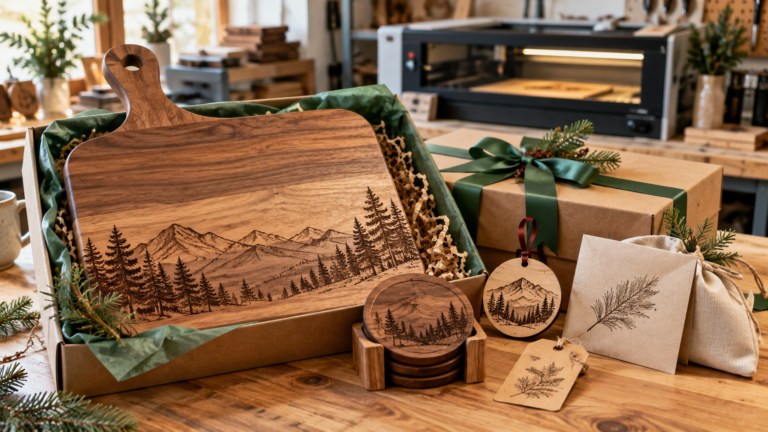
Holiday gift sets can be strong Q4 offers for laser shops, but only if the bundle is designed like a controlled product, not like three separate custom jobs shoved into one listing.
That distinction matters.
A single engraved ornament, cutting board, coaster set, leatherette patch item, or tag can already create enough design, proofing, engraving, packing, and customer-message work during Q4. When you bundle products together without rules, the order value may go up, but the production load can rise even faster.
That’s how a good-looking holiday bundle becomes a shop bottleneck.
The goal isn’t to make the biggest bundle possible. The goal is to create a gift set that feels complete to the buyer while staying repeatable for the shop. For most small laser businesses, that means one hero product, one or two low-complexity add-ons, controlled personalization, and packaging that’s solved before the listing goes live.
If you’re still choosing higher-value seasonal products, start with premium laser products for fall personalization. This guide is narrower: how to turn holiday laser products into bundles without letting custom chaos eat the margin.
Start with one hero product
A good holiday laser bundle usually needs one product that carries the emotional value.
That’s the hero product.
The hero is the item the buyer understands first. It’s the piece they would still want even if the bundle didn’t exist. It might be personalized, giftable, useful, decorative, sentimental, or tied to a specific recipient. The rest of the bundle should support that item, not compete with it.
Good hero products for laser engraved gift sets can include:
- engraved cutting boards
- personalized ornaments
- slate coaster sets
- leatherette patch items
- keepsake boxes or engraved box lids
- recipe boards
- teacher desk signs
- pet memorial ornaments or tags
- corporate thank-you plaques
- small personalized signs
- family name pieces
The hero product doesn’t need to be complicated. In fact, Q4 usually rewards the opposite. A hero product should have reliable material behavior, a repeatable file setup, a clear size, and personalization that doesn’t require a long conversation.
The trap is choosing a hero product because it looks impressive in a photo while ignoring how many decisions it creates per order. If every buyer needs a different layout, font, material, message, icon, size, proof, and shipping setup, the bundle is already drifting into custom chaos.
A better hero product has a controlled promise:
- one product type
- one or two material options
- one personalization field
- one fixed layout family
- one packaging plan
- one clear turnaround expectation
That structure gives the customer enough choice to feel personal without turning every order into a custom design project.
Add simple extras, not two more custom jobs
The easiest way to ruin a gift set is to make every item in the bundle equally custom.
A customer may love the idea of a personalized cutting board, engraved spoon, custom ornament, custom tag, handwritten recipe engraving, and gift box. The shop may not love managing six layout variables, three material behaviors, two proofing paths, and one late-night message asking if the font can be changed.
For holiday bundles, use a simpler formula:
Hero product + simple add-on + presentation add-on.
The add-ons should make the bundle feel complete without multiplying production decisions.
Examples:
| Bundle idea | Hero product | Simple add-on | Presentation add-on |
|---|---|---|---|
| Kitchen gift set | Engraved cutting board | Care card | Gift tag or belly band |
| Family ornament set | Personalized ornament | Matching name tag | Gift box |
| Coaster gift set | Slate or wood coaster set | Holiday card | Ribbon wrap |
| Teacher thank-you set | Desk sign or bookmark | Thank-you card | Pouch or small box |
| Corporate client set | Coaster set or plaque | Branded note card | Box label |
| Pet keepsake set | Pet ornament or tag | Small display card | Pouch |
Notice what the add-ons are doing. They’re supporting the perceived value, not creating a second and third full custom workflow.
A care card can be printed in batches. A gift tag can use a fixed template. A belly band can be cut or printed ahead of time. A box label can use one layout. A ribbon wrap can be prepared before orders arrive.
That’s the point.
The bundle should look intentional to the buyer and feel boringly repeatable to the shop.
Limit personalization before the listing goes live
Personalization is usually what makes laser products feel giftable. It’s also what can wreck the workflow if the listing invites too much interpretation.
The safest holiday bundles use limited personalization fields.
Good fields include:
- name
- family name
- year
- short phrase
- one date
- one fixed icon or style choice
- one logo field for corporate orders, if file rules are strict
Risky fields include:
- open-ended messages
- long quotes
- multiple names across multiple items
- uploaded handwriting
- uploaded photos
- customer-supplied artwork with no file-quality rules
- “tell us your idea” boxes
- unlimited font choices
- personalization on every item in the bundle
A simple rule helps: if the customer has to make more than three meaningful choices, the bundle is probably too complex for holiday volume.
That doesn’t mean every bundle has to feel generic. It means the options need boundaries. “Choose a name, a year, and one style” is manageable. “Tell us what you want on each item” isn’t a Q4-friendly offer unless the price is high enough to cover real custom design time.
If you want to offer deeper customization, separate it from the standard bundle. Keep the base bundle clean and repeatable, then create a custom upgrade, quote request, or premium version for buyers who need more.
Don’t hide custom design labor inside a low-priced holiday bundle.
Build bundles around production batches
A profitable bundle isn’t only a nice collection of products. It’s a production system.
Before listing a holiday gift set, ask how it moves through the shop:
- Can the hero product use the same blank size each time?
- Can the engraving settings stay consistent?
- Can names or dates be dropped into one template?
- Can add-ons be produced ahead of time?
- Can packaging be staged before orders arrive?
- Can the same box, mailer, or pouch fit every version?
- Can one photo accurately represent what customers will receive?
This is where bundles can either help or hurt.
A good bundle lets you batch work. You can engrave similar blanks together, prep gift tags ahead of time, print care cards in one run, cut ribbon to length, stage boxes, and pack orders without re-solving the presentation each time.
A weak bundle breaks batching. It uses different materials, different sizes, different proofs, different packaging, and different customer instructions for nearly every order.
For Q4, the batchable version is usually the better business decision.
Think in production groups:
- same material
- same jig or workholding setup
- same file template
- same personalization field
- same packaging size
- same insert card
- same photo promise
- same shipping profile
You can still make the offer feel special. The customer doesn’t see the workholding setup, file naming, or packing station. They see a finished gift set that feels thoughtful and ready to give.
That’s the leverage.
Price the bundle for profit, not just a bigger cart
Gift sets can raise average order value, but order value isn’t the same as profit.
A bundle that sells for more but adds too much labor can be worse than selling the hero product by itself. This is especially true when the extra items need their own engraving, sanding, cleaning, finishing, proofing, packing, or remake risk.
Don’t price a holiday bundle by adding three products together and then applying a big discount because “bundles are supposed to be cheaper.” That can work for some retail products. It’s dangerous for custom laser work.
A better pricing approach is:
Hero item price + add-on material cost + add-on labor + packaging cost + packing time + margin buffer.
Packaging matters here. A gift-ready set may need a box, filler, card, tag, ribbon, label, tissue, pouch, sticker, or insert. Those pieces may seem small, but they still cost money and handling time.
The bundle should create a reason for the customer to spend more without forcing the shop to donate the presentation work.
If you need deeper pricing support, use laser engraving custom work pricing as the foundation. For bundles, the key is to price the full workflow, not only the engraved items.
A simple test helps:
Would this bundle still be worth selling if five people ordered it on the same day?
If the answer is no, the price is too low, the bundle is too complex, or the offer should stay limited.
Gift-ready presentation is part of the product
A holiday gift set doesn’t need luxury packaging to feel complete. It needs to feel ready to give.
That’s different.
Gift-ready can be as simple as a clean box, tissue, a care card, and a small tag. For local pickup, it might be a kraft box with a belly band. For shipped orders, it may need stronger protection. For market tables, it may mean clear signage and one fully assembled sample that shows the buyer what the finished set looks like.
Useful presentation elements include:
- kraft gift boxes
- rigid mailers
- velvet or organza pouches
- belly bands
- branded thank-you cards
- product care cards
- small engraved tags
- tissue or crinkle paper
- ribbon or twine
- simple holiday-neutral props
- clean labels
Keep the packaging repeatable. If every order needs a different box or wrapping method, the presentation becomes another production step you have to price and schedule.
This also affects photos. Photograph the exact bundle customers will receive, not a styled version you can’t repeat. If the listing photo shows a box, ribbon, tag, card, and filler, those pieces need to be included, priced, and available.
For setup help, use a simple product photography setup for custom products and keep the bundle photo clear. Buyers should understand what’s included within a few seconds.
Proofing rules need to be simple
Proofing is where many custom bundles slow down.
A single custom item may need one proof. A bundle with three personalized pieces can create three proofing moments, three chances for correction, and three places where the customer may ask for something outside the listing.
Set proofing rules before the product goes live.
A clean holiday bundle might use rules like:
- only the hero product receives a proof
- one proof revision is included
- add-ons use fixed templates unless upgraded
- production starts after approval
- approval deadlines are clearly stated
- rush proofing is priced separately or excluded
- customer-uploaded artwork must meet file rules
- late approval can move the ship date
The exact policy can vary by shop, but the principle is the same: don’t let the bundle create unclear approval loops.
This matters even more close to shipping cutoffs. If buyers approve late, ask for revisions late, or change names after production starts, the shop needs a clear policy. If rush work is part of your offer, separate it from the standard bundle and price it intentionally. The rush orders for custom products guide can help with that boundary.
A good bundle tells the customer what they can customize, what they can’t, when approval is needed, and what happens if they miss the deadline.
That protects both sides.
Bundle examples that keep complexity low
Product examples are useful only if they show the structure. The point isn’t to copy every idea below. The point is to see how the bundle stays controlled.
Family ornament gift set
Hero product: personalized family ornament.
Add-ons: engraved gift tag and small gift box.
Personalization limit: family name and year.
Main risk: letting buyers add individual names, long quotes, custom icons, or multiple design changes.
This works best when the ornament template is fixed and the gift tag is either non-personalized or uses the same family name.
Teacher thank-you set
Hero product: engraved desk sign, bookmark, or small classroom sign.
Add-ons: thank-you card and pouch.
Personalization limit: teacher name only.
Main risk: long custom messages from students, parent names, school logos, or inside jokes that need layout changes.
A fixed phrase with one name field is much easier to repeat than a fully custom message.
Corporate client coaster set
Hero product: engraved coaster set or small plaque.
Add-ons: branded note card and gift box label.
Personalization limit: company name or logo, with file-quality rules.
Main risk: low-resolution logos, late approvals, and buyers expecting full corporate-gift service at small-product pricing.
This can work well, but it needs clear order minimums, proofing rules, and file requirements.
Pet keepsake set
Hero product: pet ornament, memorial tag, or small keepsake plaque.
Add-ons: pouch and simple display card.
Personalization limit: pet name and year.
Main risk: emotional orders can invite long notes, photo requests, and extra revisions.
Be kind, but keep the listing structured. A simple, respectful design is usually better than an open-ended memorial project during Q4.
Kitchen gift set
Hero product: cutting board, recipe board, or engraved utensil.
Add-ons: care card and engraved or printed gift tag.
Personalization limit: family name, short phrase, or fixed recipe/title field.
Main risk: food-safe wording, care complexity, large custom messages, and packaging that doesn’t protect the item.
If you include care instructions, make sure they match the material and finish you actually use.
When a bundle creates more work than margin
Some bundles shouldn’t be listed for Q4.
That doesn’t mean the idea is bad forever. It means the timing, price, or workflow isn’t strong enough for holiday volume.
Warning signs include:
- every piece is personalized
- the customer has to upload files
- each order needs a custom quote
- materials require different settings and prep
- packaging doesn’t fit consistently
- add-ons are fragile or remake-prone
- proofing rules are unclear
- the bundle needs too many listing photos
- the price relies on a discount instead of margin
- the offer delays simpler high-profit orders
The decision rule is blunt: if the bundle adds less profit than one extra single-item order but creates more approval, packing, and remake risk, simplify it or drop it.
A smaller bundle with clean boundaries is better than a beautiful listing that turns December into damage control.
Use the machine and materials you can run reliably
A holiday bundle isn’t the place to experiment with every blank, coating, and material you have been meaning to try.
Build the offer around the laser, materials, and settings you already trust. If you’re still choosing equipment, use a broader best laser engraver for small business guide before designing a Q4 bundle around a machine you haven’t tested.
The bundle should be based on real production confidence:
- materials you can source again
- blanks that engrave consistently
- settings that are already dialed in
- packaging that protects the finished product
- photos that match what you can deliver
- turnaround times you can defend
Don’t let a holiday bundle become a live experiment unless the order cap is low and the price reflects the extra risk.
A simple launch checklist for holiday laser bundles
Before publishing a holiday gift set, run through this checklist:
- Pick one hero product.
- Choose one or two low-complexity add-ons.
- Limit personalization fields.
- Use one fixed template family.
- Make one fully packed sample.
- Photograph the exact bundle.
- Time engraving, cleaning, packing, and customer messaging.
- Price packaging and handling into the offer.
- Write proofing rules before orders arrive.
- Decide whether rush orders are excluded or priced separately.
- Set order caps if the workflow is new.
- Define holiday cutoff dates.
- Confirm you can restock the blanks and packaging.
- Remove any option that creates too much back-and-forth.
The strongest holiday bundles aren’t always the most elaborate. They’re the ones customers understand quickly and the shop can repeat cleanly.
If the bundle raises order value, protects margin, photographs well, and keeps personalization under control, it can be worth adding to your Q4 lineup. If it only looks good in a mockup but creates too many decisions, proofs, and packing steps, simplify it before the rush starts.
FAQ
What laser engraved products work best in holiday gift sets?
The best products are giftable, easy to explain, and repeatable. Cutting boards, ornaments, coaster sets, tags, bookmarks, small signs, keepsake boxes, and simple leatherette items can all work. The material behavior, personalization field, packaging, and proofing process just need to be controlled.
How many items should be in a laser gift bundle?
Most small shops should start with two or three pieces: one hero product and one or two simple add-ons. Larger bundles can work, but they need stronger pricing, clearer proofing rules, and more reliable packaging.
Should every item in a gift set be personalized?
Usually, no. Personalize the hero product first. Keep add-ons fixed, batchable, or lightly personalized unless the bundle is priced as a premium custom offer. Personalizing every item can triple the proofing and remake risk.
How do I price custom holiday bundles?
Price the full workflow: hero item, add-on materials, engraving time, design/proofing time, packaging, packing labor, remake risk, and margin. Don’t rely on a heavy discount unless the bundle is still profitable after real labor and packaging costs.
Are holiday bundles worth it for small laser shops?
They can be worth it when they raise order value without adding too much custom work. If the bundle is easy to batch, easy to photograph, easy to pack, and easy for buyers to understand, it can be a strong Q4 offer. If it creates unclear choices, late approvals, or fragile packaging, it may be better as a limited custom option instead of a standard holiday product.