
If you’re looking for the best UV printer for a small business in 2026, the honest answer is that there’s no one universal best machine.
The right UV printer depends on what you actually plan to sell, how repeatable your orders are, how much setup complexity you can tolerate, and whether you need a compact customization machine or a more serious production tool.
That matters because UV printers are easy to misunderstand.
A lot of people see polished product demos and assume a UV printer is a simple way to add premium full-color customization to almost anything. Sometimes that’s true. Sometimes it’s a fast way to buy an expensive machine that doesn’t fit your real workflow.
For most small-business buyers, the smartest UV printer isn’t the one with the flashiest demo. It’s the one that matches the products you want to sell, the order volume you realistically expect, and the amount of daily maintenance and production discipline you can actually live with.
This guide is built around that idea. Instead of a thin roundup, this is a practical breakdown of which kind of UV printer fits which kind of small business, where desktop UV makes sense, where UV DTF is the better answer, and when a true flatbed is worth the money.
If you’re still deciding whether UV printing should even be your first machine category, read What Machine Should You Buy First for a Side Hustle? For a lot of beginners, UV is better as an intentional choice than an impulse buy.
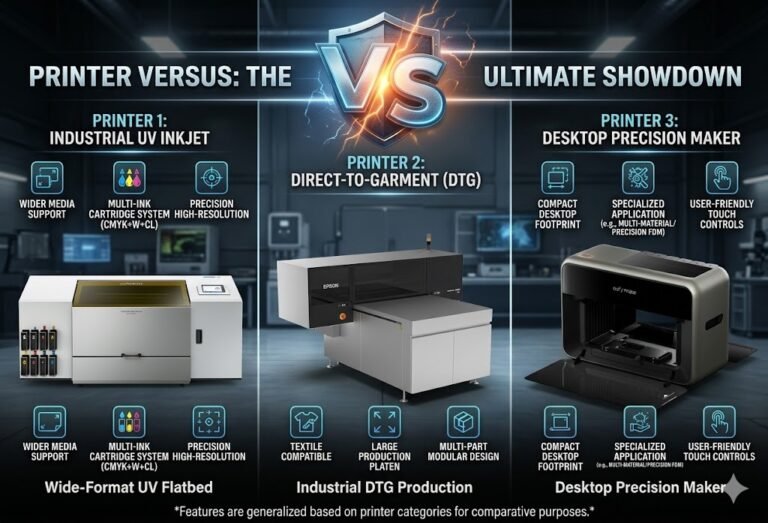
Quick picks: best UV printers for small business in 2026
These are practical category picks, not one-size-fits-all answers.
| Category | Recommended fit | Example pick | Why it stands out | Main tradeoff |
|---|---|---|---|---|
| Best for small businesses wanting a modern desktop UV workflow | Small shops customizing compact hard goods, gifts, and branded items | EufyMake UV Printer E1 | Compact desktop positioning, strong beginner appeal, good fit for creators moving into premium personalization | Smaller-format, newer ecosystem, and still a workflow that needs real maintenance discipline |
| Best UV flatbed for more serious product businesses | Small shops that need broader material handling and more production-minded capability | Epson SureColor V4000 | More business-oriented flatbed path, stronger fit for repeat product work, and better long-term credibility for serious UV operators | Higher cost, bigger commitment, and more machine than many beginners actually need |
| Best for businesses that need transfer flexibility | Shops decorating irregular items or wanting more placement flexibility | Roland UV DTF transfer system class workflow | Strong fit when direct printing is awkward and transfer-based decoration suits the catalog better | Different process, more consumable dependence, and not the same thing as true direct-to-object flatbed printing |
| Best value path for a small shop testing UV demand | Businesses validating whether UV-customized products will really sell before jumping into larger equipment | Compact desktop UV printer class machine | Lower-risk entry into hard-goods customization when the product lane is clear | Entry-level value only works when the product lane is disciplined and expectations stay realistic |
| Best upgrade path | Small businesses already proving demand and outgrowing starter desktop limits | Production-oriented UV flatbed class machine | Better consistency, better media handling, and stronger throughput potential | More space, more capital, more maintenance responsibility |
The bigger point is this: the best UV printer for your small business is often really the best type of UV workflow for your catalog.
What actually matters when choosing a UV printer for a small business
A lot of buyers start with print size or marketing samples.
That’s understandable, but it’s usually not the best place to start.
Product fit matters more than machine hype
Start with the products you want to sell.
If your business is built around:
- phone cases
- acrylic signage
- small branded items
- personalized gift products
- tumblers and coated drinkware
- promotional products
- hard-surface custom goods
- premium small-batch items
then UV printing can be a very strong business lane.
If your product idea is still vague, the machine decision gets much riskier.
The most common equipment mistake is buying a machine before you’ve a real product direction.
Direct UV printing and UV DTF are related, but they aren’t the same choice
This is one of the most important distinctions in the whole category.
- Direct UV printing usually means printing straight onto a hard surface or onto a printable substrate on a flatbed-style machine.
- UV DTF usually means creating a transfer that can be applied to suitable hard goods, which can make awkward shapes and product handling more flexible.
For some small businesses, UV DTF is actually the smarter workflow because it lets them decorate more varied objects without needing every item to sit perfectly for direct print.
For others, especially shops with repeatable flat products or controlled blanks, a direct UV flatbed workflow is cleaner and more scalable.
That’s why buyers should think about workflow before they think about rankings.
If you want more context on this part of the market, Laticy already has UV-related coverage on the Roland UV DTF Transfer System and the Epson SureColor V4000 UV Flatbed Printer.
Daily maintenance matters more than many first-time buyers expect
UV printers aren’t set-it-and-forget-it machines.
They can produce impressive results, but they also demand discipline around:
- cleaning
- ink handling
- nozzle health
- substrate prep
- curing consistency
- environmental stability
- regular use
If you want a machine you can ignore for long stretches and then fire up casually, UV may frustrate you.
That doesn’t make UV a bad business category. It just means the workflow is more operational than many beginners expect.
The best UV printer for a home-based business isn’t always the most powerful one
A lot of small-business buyers are working from home, a garage, or a compact studio.
That changes the answer.
For a home-based setup, you need to care about:
- footprint
- ventilation and room conditions
- noise and routine disruption
- consumables storage
- how awkward the loading process is
- whether the machine supports the kinds of products you can realistically batch in your space
The best UV printer for a small shop is often the one that fits your space cleanly enough that you actually use it consistently.
Support and ecosystem quality matter
If the machine is supporting paid orders, support quality isn’t a side issue.
Business buyers should care about:
- availability of consumables
- replacement parts
- service expectations
- software reliability
- training resources
- warranty clarity
A cheaper machine can still be the right decision, but only if you understand what you’re giving up.
Quick comparison table
| Machine / workflow | Best for | UV type | Budget tier | Business stage | Main strengths | Main tradeoff |
|---|---|---|---|---|---|---|
| EufyMake UV Printer E1 | Home-based makers and small brands selling customized hard goods | Desktop direct UV | $$ to $$$ | Testing demand to early consistent sales | Compact appeal, approachable category entry, premium-looking output potential | Smaller format, newer platform risk, and still requires real upkeep |
| Epson SureColor V4000 | Small businesses wanting a more serious flatbed path | UV flatbed | $$$$ | Early growth to established small shop | Stronger business positioning, better fit for repeat product work, wider credibility | Bigger investment and not ideal for casual or vague product plans |
| Roland UV DTF system class workflow | Shops needing transfer-based flexibility on varied shapes | UV DTF | $$$ to $$$$ | Clear product lane with irregular-item demand | Useful for awkward objects and flexible decoration workflows | Additional transfer steps, supplies, and process complexity |
| Compact entry desktop UV class machines | Product testing in a narrow lane | Desktop direct UV | $$ | Validation stage | Lower-risk way to test market appetite for UV products | Narrower use case, smaller working envelope, easier to outgrow |
| Production flatbed upgrade path | Repeat-demand shops needing consistency and throughput | UV flatbed | $$$$ to $$$$$ | Growing shop | Better capacity, stronger production discipline, better scaling path | Space, cost, maintenance, and operator expectations all rise |
Best UV printers by business fit
Best for small businesses wanting a modern desktop UV workflow: EufyMake UV Printer E1
For many small businesses, the most interesting newer entry point is the EufyMake UV Printer E1.
The reason isn’t that it magically makes UV easy.
It’s that it appears designed to make UV more approachable for smaller operators who want premium customization without starting with a large commercial flatbed.
Why this category makes sense:
- strong fit for home-based or compact-shop setups
- appealing for customized hard goods, gifts, branded products, and creator-led product lines
- much easier for many buyers to picture in a real small-business environment than a larger industrial-style machine
- potentially useful bridge between hobby-adjacent creators and real product businesses
Why a machine like this works best:
- your products are relatively compact
- your design quality matters more than raw throughput
- your business benefits from high-perceived-value personalization
- you want UV specifically, not just a machine that seems exciting
Main cautions:
- smaller-format convenience doesn’t eliminate maintenance
- you still need a real product plan
- desktop appeal doesn’t automatically mean long-term production depth
- newer ecosystems should be judged partly on support maturity, consumables availability, and real operator feedback over time
Natural affiliate opportunity: If Laticy has or adds a tracked partner link for EufyMake, this is one of the cleanest places to use it. The fit is straightforward, and the recommendation is rooted in workflow logic rather than hype.
For buyers who want to see Laticy’s existing coverage first, add a natural internal link here to EufyMake UV Printer.
Best UV flatbed for a more serious small-business workflow: Epson SureColor V4000
If you already know UV printing is central to the business and you want a more credible production-minded path, the Epson SureColor V4000 is one of the strongest names in the conversation.
This is the kind of machine that makes more sense when the question isn’t, “Can I experiment with UV?” but rather, “What UV flatbed gives my small business a more serious foundation?”
Why it stands out:
- stronger fit for repeatable product work
- better match for buyers who want a real flatbed workflow instead of just testing the category
- good brand credibility for businesses that care about long-term support confidence
- better alignment with shops that want UV to become a core capability, not a novelty add-on
Who should look hardest at this type of machine:
- businesses with a clear hard-goods product line
- shops selling repeatable branded items or customized goods at consistent volume
- operators who already understand that maintenance, substrate handling, and setup discipline are part of the job
- buyers who want to build a cleaner long-term UV workflow instead of making do with a limited stopgap
Who probably shouldn’t start here:
- buyers still figuring out what they want to sell
- anyone stretching hard just to own a more impressive machine
- very early side hustles that haven’t yet validated demand for UV-customized products
Laticy already has a dedicated piece on the Epson SureColor V4000 UV Flatbed Printer, so this article should send qualified readers there naturally.
Best for businesses that need transfer flexibility: Roland UV DTF transfer workflow
A lot of small-business buyers assume the choice is simply between desktop UV printers and larger flatbeds.
That leaves out an important middle conversation.
For some businesses, especially those decorating awkward hard goods or wanting more flexibility in application, a UV DTF transfer workflow is actually a better fit than direct printing.
That’s why a Roland UV DTF system class workflow deserves a place in this guide.
Why this lane makes sense:
- useful when direct printing onto the item is inconvenient
- can help with products that are harder to position consistently on a flatbed
- may suit shops selling a wider variety of hard goods with transfer-friendly surfaces
- can be attractive for promotional-product and customized-goods businesses that value placement flexibility
Main tradeoffs:
- this is a process choice, not just a machine choice
- transfer materials and workflow steps add complexity
- not every business wants another handling stage
- some shops will still prefer the simplicity of direct printing when the product set is controlled
This is a good place to link readers to Laticy’s existing Roland UV DTF Transfer System coverage.
Best value path for testing UV demand without overcommitting: compact desktop UV class machine
I am intentionally keeping this category broader than one forced model winner.
That’s because the right value choice depends heavily on what you’re trying to validate.
If your business is still proving whether UV-customized products will sell, the best value move is often not the absolute cheapest machine.
It’s the machine that lets you test one clear product lane without overbuying for every future possibility.
That could mean:
- a compact desktop UV machine for a narrow hard-goods catalog
- a focused starter workflow around small branded items
- a controlled set of repeatable products instead of a broad anything-shop promise
This kind of buy can make sense if:
- you already know the product lane reasonably well
- your order volume is still modest
- your space is limited
- your business can live with a narrower working envelope
- you’re disciplined enough not to let the machine choice outrun the market proof
This kind of buy usually doesn’t make sense if:
- you’re already getting regular demand that needs faster fulfillment
- you need broad substrate flexibility immediately
- you want to offer everything from signage to drinkware to promotional goods on day one
- you’re treating a budget cap like proof that a smaller machine is the right fit
The real value is in buying accurately, not just cheaply.
Best upgrade path once UV demand is real: production-oriented UV flatbed class machine
Once the business already knows UV products are selling, the conversation changes.
At that point, the biggest problem is often no longer “Can UV work for me?”
It becomes “What setup supports repeat production without unnecessary friction?”
That’s where a production-oriented flatbed class machine starts making much more sense.
This path is usually right when:
- repeat demand is already proven
- order consistency matters
- throughput matters
- product quality and placement consistency matter
- you want UV to be a serious capability, not just an experiment
This is also when buyers need to stop romanticizing “starter machine” economics.
If the business is clearly past the testing stage, buying too small can cost more than buying right.
That same pattern shows up in laser buying too, which is why Laticy’s piece on Can a Budget Laser Engraver Actually Support a Business? should fit naturally elsewhere in the site cluster.
Common mistakes small-business buyers make with UV printers
Buying the machine before locking the product lane
A UV printer isn’t a strategy.
If you don’t know what products you want to sell, how they price, and why customers would buy them, the machine decision is premature.
Underestimating maintenance
If you treat UV maintenance like an optional side task, the machine usually pushes back.
Assuming bigger is automatically better
A larger or more expensive machine only helps if your products, order flow, and space actually justify it.
Picking direct print when the catalog really wants transfer flexibility
This is where some buyers would have been better served by UV DTF.
Overbuying before validating pricing and margins
Before stretching for a larger machine, use Laticy’s Product Pricing Calculator and make sure your products can realistically support the equipment decision.
My practical recommendation by business stage
If you’re still testing whether UV products will sell
Start narrower than your ambition.
A compact desktop UV workflow can make sense if the product lane is clear. If the product lane isn’t clear, you may be better off stepping back and refining the business idea first.
If you already know your catalog and want a home-based premium customization setup
A machine in the EufyMake UV Printer E1 category is one of the more practical places to look.
If UV is going to be a core business capability, not just an add-on
Look harder at the Epson SureColor V4000 class of decision and other serious flatbed paths.
If your products are awkward to place or vary a lot in shape
Don’t force direct print just because it seems simpler on paper. A UV DTF workflow may actually fit the business better.
If your budget is tight
Don’t try to buy a machine that supports every possible future idea.
Buy for one clear, profitable product lane first.
That’s usually the healthier small-business decision.
FAQ
What is the best UV printer for a small business?
The best UV printer for a small business depends on the products, volume, and workflow. For compact customized hard goods, a desktop UV machine may be enough. For more serious repeat production, a stronger flatbed like the Epson SureColor V4000 is often a better fit.
Is a UV printer worth it for a small business?
Yes, if the business is built around products that benefit from premium hard-surface customization and the margins support the workflow. No, if the product idea is still vague or the maintenance reality doesn’t fit how the business actually runs.
What is the best UV printer for a home-based business?
For many home-based businesses, a compact desktop UV printer is the most realistic starting point because footprint and routine usability matter so much. The best home-based option is usually the one that fits the space and product lane cleanly enough to be used consistently.
Should I buy a UV printer or a UV DTF printer?
Buy based on workflow. If you mostly print onto controlled flat or direct-print-friendly items, a direct UV printer may be better. If you need more flexibility for irregular objects or transfer-style application, UV DTF may be the smarter route.
Is the Epson SureColor V4000 good for a small business?
Yes, for a small business that already knows UV printing is central to the catalog and wants a more serious flatbed workflow. It’s usually a better fit for a committed product business than for a casual beginner.
Is the EufyMake UV Printer E1 good for small businesses?
It looks like one of the more interesting desktop UV options for small businesses that want compact premium customization capability. It makes the most sense for shops with a clear small-format hard-goods lane, not for buyers who need broad production capability immediately.
How much should a small business spend on its first UV printer?
Spend based on validated product demand, not excitement. Many small businesses should start with a narrower, more controlled UV setup than they first imagine, especially if they’re still proving the market.
Final thought
The best UV printer for a small business in 2026 isn’t the machine with the most impressive sample pack.
It’s the one that fits the business you’re actually running.
If your products are compact, premium, and customization-led, a desktop UV path may be exactly right.
If your orders are repeatable and UV is becoming a core capability, a stronger flatbed path makes more sense.
If the products are awkward enough that direct print becomes annoying, UV DTF may be the better lane.
The smartest buyers don’t chase the broadest promise.
They buy the workflow that gives their business the clearest shot at making money consistently.
[…] you’re still comparing machines, start with Best UV Printer for Small Business in 2026 for the broader category view. This article is narrower on purpose: not which machine to buy, but […]
[…] Best UV Printer for Small Business in 2026 […]