
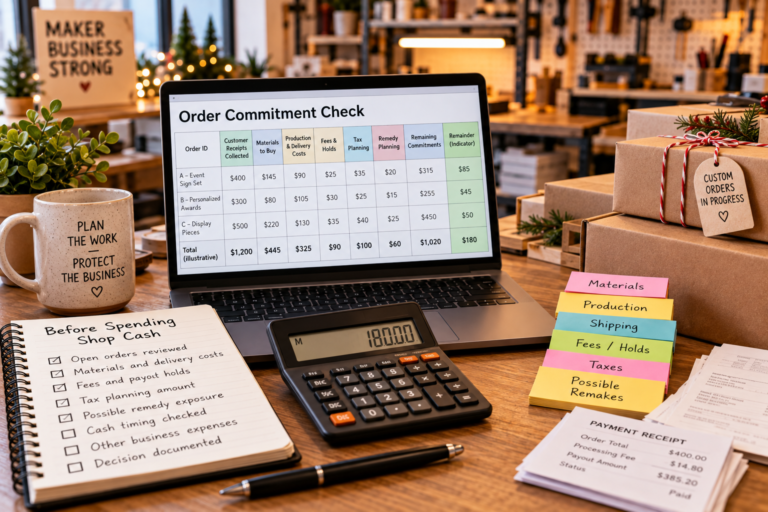
A run of holiday deposits can make a maker business look unusually cash-rich. Three customers approve custom work, payments land over a weekend, and the balance jumps before Monday. It’s tempting to read that number as a green light: a new tool, extra stock for an unrelated product line, or a general bill.
The balance alone can’t answer that question. The shop may still owe materials, production, packaging, delivery, and a finished item that matches the approved order. Payment processors may deduct fees or delay part of a payout. If an order turns up late, damaged, or wrong, the shop may owe a response under its actual terms and applicable rules. Tax and accounting treatment can also differ from the simple fact that cash arrived.
That doesn’t mean the law requires every customer deposit to sit untouched, or that every deposit gets recorded the same way. It means money in the account isn’t proof that it’s free for unrelated spending while the shop still owes work and order-specific costs. An order-commitment check puts those unfinished promises in view before the owner’s next spending decision.
This is an operating worksheet. It isn’t a rule for revenue recognition, tax reporting, refunds, or cash reserves. Those questions turn on facts a short article can’t settle, such as the customer agreement, what’s been delivered, and the business’s accounting method. The reporting framework, jurisdiction, platform terms, and applicable law matter too. Use the check to build better records and sharper questions for a qualified accountant or attorney. Don’t use it to replace them.
Start with three different questions
A customer payment creates several facts at once, and they aren’t interchangeable. Keeping three questions apart stops a bank balance from doing work it can’t do.
The first question is cash. How much did the customer pay, how much did the processor actually send, and is any amount still pending or held? This is a reconciliation question. A $600 charge and a $582 payout are connected. But they aren’t the same number if the processor took $18 before payout.
The second question is accounting and tax treatment: when and how should the shop report the transaction? The payout date alone doesn’t supply that answer. IRS Publication 538 covers the general federal income-tax timing. Under the cash method, a business generally reports income when it receives it. Under the accrual method, it generally reports income when it’s earned. The publication also has more detailed rules for advance payments. Financial-reporting frameworks can ask when promised goods or services transfer to the customer. State and local tax rules can add their own timing, sourcing, and filing questions. A maker shouldn’t turn any one of these general principles into a universal do-it-yourself rule.
The third question is operational capacity. Once the shop knows what it still expects to spend or make good on for open orders, how much room seems to remain? This is a planning question. It isn’t an accounting classification, and it doesn’t declare the remainder profit. It’s also the question this article is built to help answer.
Cash can arrive before production is finished. Revenue recognition can follow rules that don’t mirror the bank feed. Tax timing can differ by method and jurisdiction. Operationally uncommitted cash is a management estimate built from unfinished work. Don’t let one of these numbers stand in for the others.
Build the check from open orders, not from the account total
List every order that still owes a next step
Start with every customer order where the shop has taken money but still owes a meaningful next step. That could be a proof, special-order material, production, or finishing. It could also be packaging, shipment, installation, pickup, or a promised correction. If a job isn’t fully delivered and closed under the shop’s process, it belongs on the review.
Give every receipt an order ID. Record the gross customer payment, the processor payout received, and any fee deducted. Add any amount still pending or held, plus the balance the customer still owes. That gives a traceable path from customer to order record to payment activity. IRS Publication 583 stresses keeping records that identify where receipts came from, along with supporting documents. An order-level record makes that habit useful for daily operations, not just later reporting.
Estimate what each job will still cost
Next, estimate the cash commitments still attached to each job. Use current supplier quotes and actual shop records where possible. A material number copied from an old quote is weak evidence if the blank, freight, or finish price has changed. Include the packaging and delivery costs the shop agreed to absorb. Include outside services and paid helper time that will need cash. Platform charges or payout holds may not show in the cash figure yet. If they don’t, list them separately rather than pretending the customer’s gross payment is in hand.
Possible customer remedies need careful wording. Don’t invent a refund percentage or assume every problem ends the same way. Instead, flag the exposure that comes from the shop’s actual quote, cancellation and remake terms, platform rules, delivery representations, and applicable law. A planning amount can stop one remake from eating another customer’s material money. But it’s an internal estimate. It doesn’t say a particular remedy is owed, and it isn’t a legally mandated reserve.
Taxes call for the same restraint. If the shop’s accountant supplied a planning set-aside, show that amount and its basis. If the treatment is unresolved, mark it “review required” instead of picking a percentage off the internet. The check should expose uncertainty, not hide it behind false precision.
An illustrative three-order walkthrough
Imagine a small personalization shop that has collected $1,200 in gross customer receipts across three unfinished jobs. The example is fictional, and its amounts are planning estimates. They aren’t recommended prices, deposit percentages, accounting entries, tax calculations, or reserves.
| Open order | Customer receipts collected | Materials still to buy | Production and delivery cash costs | Fees or payout holds not yet reflected | Tax-planning placeholder | Possible-remedy planning amount | Remaining order commitments | Operational remainder indicator |
|---|---|---|---|---|---|---|---|---|
| A: event sign set | $400 | $145 | $90 | $25 | $35 | $20 | $315 | $85 |
| B: personalized awards | $300 | $80 | $105 | $30 | $25 | $15 | $255 | $45 |
| C: branded display pieces | $500 | $220 | $130 | $35 | $40 | $25 | $450 | $50 |
| Illustrative total | $1,200 | $445 | $325 | $90 | $100 | $60 | $1,020 | $180 |
Reading the totals
For each row, the shop adds up the remaining commitment estimates and subtracts that total from the receipts collected. Across all three jobs, the shop has collected $1,200. Of that, $1,020 is still mapped to expected costs: materials, production and delivery, fees or holds, a tax-planning placeholder, and possible-remedy planning amounts. The $180 left over is an operational remainder indicator.
It isn’t automatically profit, and it isn’t necessarily the amount the owner can withdraw. It doesn’t account for every overhead bill, debt payment, owner-pay decision, or timing mismatch elsewhere in the business. Some listed amounts may end up costing less, and others more. A platform may later release a payout hold rather than keep it. The tax placeholder may change after professional review. The value of the exercise is simple: the owner sees those assumptions instead of treating the full $1,200 as spare cash.
Add timing to the picture
Now add timing. Order A’s materials are available today. Order B needs an outsourced process that the shop must pay for before shipment. Meanwhile, Order C’s platform hasn’t released the full payout. A combined total can hide those differences, so keep the order rows visible and attach a needed-by date to each expected outflow. Otherwise, the shop can have enough cash “in total” that still arrives too late for the job that needs it first.
Say the account holds $1,200 from these orders plus older business cash. The check still shouldn’t claim that particular dollars are legally segregated. It just tells the operator that open jobs should consume $1,020 of these receipts in this illustration. So the question before an unrelated purchase isn’t “Is there money in the account?” It’s “Once the unfinished orders and their timing are visible, does the business still have room for this purchase?”
Use estimates without pretending they are exact
An order-commitment ledger will contain estimates. That’s fine as long as they’re labeled and refreshed. The dangerous version isn’t an estimate. It’s an invisible assumption.
A useful row records the source and date behind each amount. “Birch blanks: supplier cart, October 27” beats “materials: probably $100.” A shipping label estimate based on packed weight beats last season’s average if the current order is oversized. And the processor fee shown on the transaction detail beats a remembered rate applied to every channel.
When an amount is uncertain, give it a status instead of fake certainty. Mark it confirmed, estimated, pending quote, held by platform, or review required. If the shop can’t yet estimate an unusual finish or freight charge, that order isn’t ready to support unrelated spending. The blank is information, not zero.
Keep owner labor visible even when it doesn’t trigger an immediate cash payment. It should already be part of the job’s price. That’s where the Product Pricing Calculator can help test a product’s cost and margin assumptions. In the commitment check, separate unpaid owner time from payroll, contractor charges, and other cash outflows. Otherwise the ledger can double-count labor or, just as easily, pretend production time has no value.
Connect the ledger to the custom-order workflow
The order-commitment check works best as a small part of the order process the shop already runs. The repeatable custom order workflow covers intake, quotes, proofs, payment status, production, handoff, and archiving. This ledger doesn’t replace those stages. It adds a money view to each open job.
At payment, record the gross receipt, expected payout, fee, hold, and customer balance. At proof approval, refresh the material spec and quantities. Before production, swap rough estimates for real supplier orders and scheduled outside work. When the order ships or the customer picks it up, record delivery costs and any remaining balance. At closure, resolve unused planning amounts and save the final actual costs for the next quote.
That last step matters. If a $40 packaging estimate keeps turning into $68, the problem goes beyond today’s cash check. Future prices and quotes may be too low. Comparing estimated and actual commitments turns the ledger into feedback, not just another static spreadsheet.
A shop can keep this in a spreadsheet, project tracker, or accounting workflow, but the tool doesn’t decide the treatment. The Wave Accounting Review is a contextual overview of one bookkeeping product. It isn’t authority for classifying a deposit, recognizing revenue, or deciding tax treatment. Whatever tool the shop uses, someone reading the records still needs to follow the source order, payment activity, open obligations, and professional adjustments.
Run the check before unrelated spending
Pick a repeatable trigger. A weekly review can work for a low-volume shop. A busy seasonal operation may need to update the ledger whenever a large payment lands or material pricing changes. The same goes for a platform holding a payout or an order running into a delivery problem.
First, reconcile customer receipts to order records and processor activity. Then update remaining materials, outside work, paid labor, packaging, and delivery. Mark unresolved fees and holds. Review remedy exposure against the shop’s real terms and the facts of the job. Only carry forward a tax-planning amount that has a documented basis, and flag anything that needs professional review.
Next, compare the total against cash timing. A supplier charge due tomorrow and a payout expected next week don’t cancel each other out today. Finally, look beyond the orders. Overhead, payroll, debt, owner compensation, and other commitments can eat the apparent remainder. The order check is one layer of a cash decision, not the whole decision.
If the purchase would depend on an uncertain payout, an unpriced remake, or materials nobody has quoted yet, pause. That isn’t a legal reserve rule. It’s ordinary operating caution: don’t spend the same capacity twice.
Know where this check stops
This worksheet doesn’t decide whether an amount is refundable, nonrefundable, earned, taxable, deferred, or a liability. Labels like deposit, advance payment, prepayment, or retainer aren’t safely interchangeable. They don’t settle those questions on their own, either. The actual agreement, performance, accounting method, and financial-reporting framework can all matter. So can the jurisdiction, platform rules, and applicable consumer law.
It also doesn’t create a universal delivery or refund rule. Take the Federal Trade Commission’s Mail, Internet, or Telephone Order Merchandise Rule. It applies to covered merchandise orders and addresses shipment representations, delay consent, and refunds for unshipped merchandise. That’s a reason to have the shop’s channel, promises, and facts reviewed. It isn’t a reason to paste a blanket rule onto every custom order.
Start with an accountant. Find out which accounting and tax rules apply and how to record advance payments. Confirm when reporting happens and what records should support the treatment. Then have qualified legal counsel review deposit, cancellation, remake, delay, and refund language for each place and channel where the shop sells. Once you have those answers, set up the operational ledger to match them.
The cautious conclusion is simple. Money in the account shows that cash arrived. It doesn’t prove that cash is free for unrelated spending while the shop still owes materials, production, and delivery. Possible remedies under its actual terms, platform fees or holds, taxes, and other order-specific obligations still count against it too.
FAQ
Are all customer deposits liabilities?
No blanket statement is safe here. Classification depends on the governing accounting framework, the agreement, what the business has performed, and other facts. Some frameworks use a contract-liability concept when a business receives payment before the related goods or services transfer. But that principle shouldn’t become “all deposits are liabilities” for every maker, transaction, and reporting purpose. Have a professional review the treatment for the business.
Does receiving a deposit mean it is taxable immediately?
The receipt date alone doesn’t give a universal answer. Federal income-tax timing can depend on the accounting method and detailed advance-payment rules. State and local taxes can raise separate questions. IRS Publication 538 describes general cash- and accrual-method timing and includes specific material on advance payments. A qualified tax professional should apply the current rules to the business’s facts.
Should a maker keep deposits in a separate bank account?
This article doesn’t prescribe an account structure, and the operational check doesn’t create a legal segregation requirement. Its job is to make order commitments visible wherever the cash sits. Ask the business’s accountant and attorney whether any account, trust, merchant, contract, or jurisdiction-specific requirement applies.
How much of a custom order should be collected as a deposit?
This guide doesn’t offer a universal percentage. The amount is a pricing, risk, workflow, and terms decision that should fit the job and applicable rules. Whatever the business chooses, state the payment and cancellation terms clearly and tie each receipt to the right order.
Is the operational remainder the same as profit?
No. It’s a planning indicator after selected open-order commitments, based on estimates at one point in time. Profit is an accounting measure. A spending decision also has to weigh overhead, payroll, debt, owner compensation, timing, and other commitments outside the order rows.
What should happen when an order closes?
Confirm delivery and final payment, post actual fees and fulfillment costs, resolve any hold or adjustment, and keep the supporting records. Then compare estimated commitments with actual results. That comparison can reveal weak quotes, missing cost categories, and recurring delivery or remake exposure before the next busy period.