
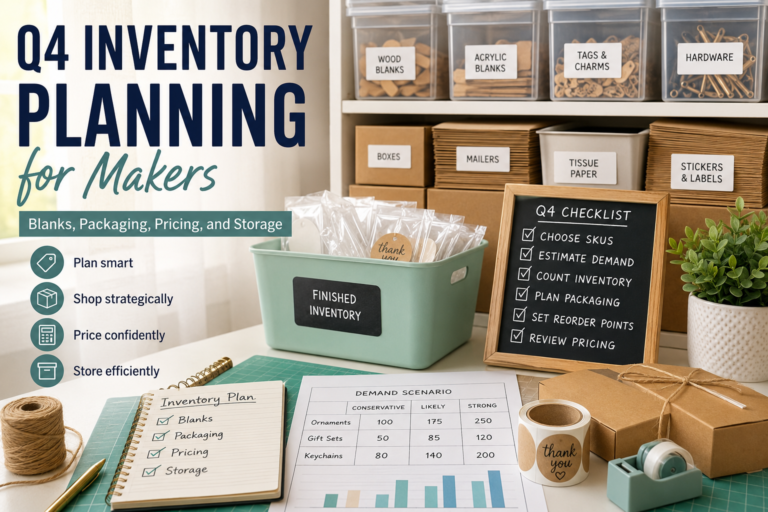
By late July, most maker businesses don’t need more holiday ideas. They need an inventory plan they can actually store, afford, count, reorder, and price correctly before the busy season gets crowded.
That’s a different problem than deciding what to make.
A product can be a good Q4 idea and still become a cash problem if you buy too many blanks, forget the packaging, underestimate spoilage, or fill your shelves with slow-moving variants before you know what customers will actually buy. The goal isn’t to buy everything early. The goal is to know what deserves inventory, how much room it’ll take, when to reorder, and whether the margins still work before your cash is tied up in supplies.
For Q4, makers should think less like collectors and more like operators. Every blank, box, mailer, label, insert, ribbon, acrylic sheet, wood round, ornament, tag, or hardware pack should connect to a product plan.
If you can’t name the product it supports, where it’ll be stored, how it’ll be packed, and when you’ll reorder it, it probably shouldn’t be a deep buy yet.
The Goal Is Usable Inventory, Not More Inventory
Holiday inventory feels safer when there’s more of it on the shelf. Sometimes that’s true. Often, it isn’t.
More inventory helps when it supports products you know you can sell and ship profitably. It hurts when it becomes clutter, locks up cash, forces rushed discounting, or hides the fact that your pricing no longer works.
Usable inventory has a job. It’s tied to a product you actually plan to sell. It fits your real storage space. It can be counted without digging through mystery boxes. It uses packaging you already understand. It gives you enough time to reorder before panic mode. And it’s priced with current material, packaging, shipping, labor, and spoilage costs in mind.
Inventory that doesn’t meet those standards isn’t preparation. It’s a bet.
That doesn’t mean every small shop needs a warehouse system. It means the inventory you buy should be specific enough to operate. A bin of blanks you can count is useful. A pile of mixed supplies you vaguely remember ordering isn’t.
Start With a Hard SKU Limit Before Buying Anything
A SKU isn’t just a product listing. It’s an inventory obligation.
Every extra product variant can create more blanks to track, more packaging to store, more labels to print, more photos to manage, and more small decisions during the busiest part of the year. A shop with ten well-controlled holiday products can be easier to run than a shop with forty “maybe” products scattered across bins.
Before you buy deeply, split your Q4 products into three groups.
Core products are the items you’ve the most confidence in. These might have prior sales, strong customer interest, easy repeatability, clear gift appeal, or a good fit with your existing materials and packaging. They deserve the most inventory attention.
Test products are promising but not proven. They may deserve a small blank order, a limited packaging setup, or a controlled first batch, but not a full Q4 stockpile.
Drop or delay products are the ones that sound nice but create too much complexity for the season. They may require unusual blanks, special packaging, awkward storage, too many personalization variables, or too much one-off design time. Those can stay made-to-order, move to a later season, or disappear entirely.
This is where discipline matters. A weak product doesn’t become better because you bought 100 blanks for it.
If a SKU adds storage, sourcing, packaging, or production complexity without a strong reason, cut it before the inventory order, not after.
Plan Blanks by Demand Scenario, Not Optimism
A common Q4 mistake is buying blanks based on excitement instead of a simple demand range.
You don’t need perfect forecasting. You need a reasonable plan that keeps you from underbuying obvious winners or overbuying products that are still guesses.
For each core product, estimate three levels:
- Conservative demand: what you would expect if the season is steady but not exceptional
- Likely demand: what seems realistic based on prior sales, audience size, market plans, and current interest
- Strong demand: what could happen if the product performs well or gets a good social, market, or repeat-customer push
Then connect the blank count to the actual product.
If one ornament uses one blank, the math is simple. If a gift set uses two tags, one backing card, one box, one label, and one mailer, the inventory plan needs to count every component. If a product uses a shared blank that works across multiple listings, that blank may deserve a deeper buy than a specialized blank that only supports one untested item.
Shared materials are usually safer than narrow materials. A wood round, acrylic blank, tag, insert, box, or label that can support several products gives you room to adjust during the season. A blank that only works for one weak design is riskier.
Before you buy, ask what happens if demand shifts. Can the material move into another product? Can the packaging still be used? Can the blank survive into another season? Or does the whole purchase depend on one listing performing exactly as hoped?
Add Spoilage on Purpose
Don’t plan Q4 inventory as if every blank becomes a sellable product.
Some blanks will be damaged. Some will engrave poorly. Some will print with defects. Some will be lost to setup testing, finish problems, personalization errors, packaging mistakes, customer changes, or quality checks.
That doesn’t mean you need a huge buffer for every product. It means spoilage should be part of the plan instead of a surprise.
For simple repeat products, a small unit buffer may be enough. For personalized products, new materials, fragile blanks, painted finishes, layered pieces, tight alignment, or products with more manual handling, the buffer may need to be larger.
The practical question is simple: if five pieces fail during production, does that break the order plan, or did you account for it?
Spoilage also affects pricing. If you need ten finished pieces but usually lose one or two to setup, defects, or quality control, the cost of those failed pieces still belongs somewhere. Pretending they don’t exist makes the product look more profitable than it’s.
Packaging Needs Its Own Inventory Plan
Packaging is where a lot of small shops get surprised.
They plan product blanks, then realize later that they don’t have enough boxes, sleeves, tissue, backing cards, labels, bubble mailers, inserts, tape, void fill, hang tags, or gift-ready packaging. A finished product that can’t be packed cleanly isn’t ready to ship or sell.
For Q4, separate packaging into four groups.
Primary packaging is what touches or presents the product: boxes, sleeves, backing cards, bags, wraps, tags, or inserts.
Protective packaging keeps the item safe: padding, rigid mailers, bubble wrap, corrugated inserts, corner protection, tissue, or dividers.
Shipping packaging gets the order out the door: mailers, shipping boxes, tape, labels, and packing slips.
Brand or gift packaging adds perceived value: stickers, thank-you cards, ribbon, premium boxes, gift tags, or seasonal inserts.
Each layer has a cost. Each layer takes space. Each layer can become a bottleneck.
A shop can have plenty of ornaments, tags, shirts, engraved gifts, or printed blanks ready to go and still get stuck because the right mailer or product box is out of stock.
Standardize Packaging to Protect Margin and Storage Space
The easiest packaging system to manage is usually not the prettiest one. It’s the one that works across multiple products.
If you can standardize around one or two mailer sizes, one backing-card system, one box style, and a small set of label formats, your Q4 inventory becomes easier to count and reorder. It also takes less storage space than a different packaging setup for every product.
Premium packaging can make sense, but only when the product price supports it. Gift-ready boxes, special inserts, ribbons, and upgraded presentation should either help justify a higher price or belong to a specific premium product line. If every low-margin item gets expensive packaging, the holiday rush may feel busy while quietly shrinking profit.
Before buying packaging in bulk, ask:
- Which products can share the same packaging?
- Which packaging items are required before an order can ship?
- Which packaging upgrades are optional or premium?
- Which packaging items take the most storage space?
- Which packaging costs need to be reflected in the product price?
Packaging isn’t decoration after the business decision. It’s part of the business decision.
Use Storage Space as a Planning Constraint
Inventory doesn’t only cost money. It costs space.
That matters in a garage shop, spare room, craft room, basement, studio, shed, or small commercial space. A product line that looks profitable on paper can become a daily drag if it fills every shelf, blocks production surfaces, scratches finished goods, or makes counts impossible.
Before buying Q4 inventory, decide where each category will live.
Raw blanks should have their own space. Packaging should have its own space. Finished inventory should have its own space. Damaged or questionable items shouldn’t be mixed into sellable stock. Event inventory shouldn’t be scattered across the same bins as online-order inventory unless the system is clearly labeled.
A simple storage plan might include clear bins for blanks, divided trays for small tags or charms, shelf zones for packaging, labeled boxes for finished goods, and a separate area for seasonal overflow.
The system doesn’t have to be fancy. It has to be countable.
If you can’t quickly see how many blanks, boxes, labels, or finished pieces are left, you’ll either overbuy because you feel unsure or underbuy because the shortage stays hidden until it matters.
Set Max-on-Hand Limits, Not Just Minimums
Most makers think about running out. Fewer think about owning too much.
A reorder point tells you when to buy more. A max-on-hand limit tells you when to stop.
That second number protects cash and space.
For example, a best-selling ornament blank might deserve a high max because it sells every season, stores well, and works across several designs. A trendy color variant might need a low max because demand is uncertain and it doesn’t transfer well to other products.
Set the maximum based on storage space, cash comfort, supplier reliability, product confidence, and whether the material can be reused in other offers.
If a product needs its own special blank, special box, special label, and special storage area, the max-on-hand should be tighter unless sales history proves otherwise.
This is also where bulk discounts need a sanity check. A lower unit cost isn’t automatically a better decision if the extra inventory sits for months, crowds the shop, or pushes cash away from products that sell faster.
Reorder Points Matter More Than One Giant Buy
A giant early inventory order can feel efficient. Sometimes it’s. But for many small shops, a clear reorder system is safer than trying to guess the entire season in one purchase.
A simple reorder point should consider three things:
- How quickly you use the item
- How long the supplier usually takes
- How much buffer you need if demand spikes or shipping slows down
If a blank usually lasts three weeks and the supplier takes 10 to 14 days, you shouldn’t reorder when the bin is almost empty. You should reorder while there’s still enough stock to cover the lead time.
The same logic applies to boxes, mailers, labels, tape, backing cards, inserts, hardware, finishing supplies, and replacement parts. Q4 shortages aren’t limited to product blanks.
The highest-priority reorder points usually belong to items with long lead times, supplier minimums, inconsistent availability, fragile quality, or broad use across multiple products.
A shared mailer size used for half your shop may deserve tighter monitoring than a decorative insert used for one optional upgrade.
Review Pricing Before You Lock Cash Into Inventory
Inventory planning and pricing are connected.
If your blank costs, packaging costs, inbound shipping, platform fees, or shipping protection have changed, the old price may not support the new inventory plan. Buying deeper into a product with weak margins doesn’t fix the margin. It just makes the problem larger.
Before you restock heavily, review the real cost of each core product:
- Blank or raw material
- Spoilage allowance
- Packaging
- Labels and inserts
- Platform or payment fees
- Shipping protection
- Labor time
- Storage burden
- Discount or promotion plans
If the numbers are tight, use the Product Pricing Calculator before committing to a deep restock. If your costs have moved since the last time you priced the product, Laticy’s guide on material and shipping cost changes for maker product pricing can help you decide whether the product still deserves shelf space at its current price.
The point isn’t to reprice your whole shop every week. It’s to avoid buying deeply into products whose costs have quietly changed.
Some products shouldn’t be stocked for Q4 just because they’re cute. They should earn their shelf space.
Watch for Inventory That Quietly Traps Cash
Bad inventory doesn’t always look bad at first.
It may look like a good deal on a bulk pack, a seasonal color you were excited about, a new product line you meant to photograph, or packaging for an offer that never got traction.
The danger signs are simple:
- Large minimum orders for unproven products
- Too many color, size, or style variants
- Packaging that only fits weak sellers
- Blanks that don’t work across multiple SKUs
- Finished goods waiting on photos, listings, or unclear pricing
- Supplies bought because of a sale instead of a plan
- Inventory that’s hard to count without unpacking everything
The earlier you catch this, the better.
A small inventory review in August can prevent a bigger cash problem in November. Look for products that are tying up space without supporting revenue. Decide whether they need better listings, a smaller batch, a bundle, a price change, or removal from the Q4 plan.
The point isn’t to shame past purchases. It’s to stop weak inventory from steering the rest of the season.
A Practical Late-July to August Inventory Workflow
If Q4 planning feels too big, keep the workflow simple.
In the first pass, lock the SKU list. Decide what is core, what is test-only, and what should be dropped, delayed, or made-to-order.
In the second pass, count what you already have. Count blanks, packaging, labels, shipping supplies, and finished goods separately. Don’t rely on memory.
In the third pass, assign storage. Decide where each product family, blank type, packaging item, and finished batch will live. Label the bins or shelves before the season gets busy.
In the fourth pass, set reorder points for key supplies. Focus on the items that would stop production or shipping if they ran out.
In the fifth pass, review pricing. Before you buy deep, make sure the current product price still supports the real cost of blanks, packaging, spoilage, labor, and shipping.
That’s enough structure for most small shops. You can make it more detailed later, but the first win is simple: fewer mystery supplies, fewer rushed reorders, fewer overbought weak products, and fewer products that look profitable only because the full inventory cost was ignored.
End-of-July Q4 Inventory Checklist
Before you place large Q4 supply orders, check the basics:
- Core holiday SKUs are chosen
- Weak variants are cut or made-to-order
- Blank counts are estimated by demand scenario
- Spoilage buffer is included
- Packaging components are counted separately
- Storage bins or shelves are assigned
- Finished inventory has its own space
- Reorder points are set for key supplies
- Max-on-hand limits are clear for risky or bulky items
- Pricing is reviewed against current costs
- Cash tied up in inventory still feels acceptable
- Supplier lead times are checked before the season gets tight
That checklist won’t make Q4 effortless. But it’ll reduce the avoidable problems: mystery stock, missing packaging, rushed reorders, overbought weak SKUs, and products that looked profitable before the real costs showed up.
FAQ
How Much Holiday Inventory Should a Maker Keep on Hand?
Enough to support proven products through realistic demand, supplier lead times, and a small spoilage buffer. Avoid buying deeply for untested products unless the blanks or packaging can be reused across other offers.
Should Small Shops Buy Packaging Before Product Blanks?
Not usually before the product plan is clear, but packaging should be planned at the same time as blanks. A product isn’t ready for Q4 if you can make it but can’t pack, protect, label, or ship it consistently.
When Should Makers Reorder Q4 Supplies?
Reorder before the last usable week of inventory, not when the bin is empty. Your reorder point should account for supplier lead time, expected weekly usage, and a safety buffer for delays or demand spikes.
How Do I Plan Holiday Inventory if I Don’t Know Demand Yet?
Use smaller test batches, shared materials, and lower max-on-hand limits. Keep deep inventory for products with stronger proof, repeat sales, or materials that can support multiple listings.
What Inventory Should Stay Made-to-Order Instead of Stocked?
Products with uncertain demand, expensive or bulky materials, too many personalization variables, fragile storage needs, or narrow packaging requirements may be better as made-to-order until sales justify deeper stock.
Final Takeaway
Q4 inventory planning isn’t about buying as much as possible before everyone else does. It’s about controlling the season before the season controls the shop.
The best inventory plan is selective. It gives strong products enough support, keeps weak products from swallowing cash, makes packaging part of the plan, and keeps storage countable.
By late July, the smartest question isn’t “what else can I make?”
It’s: what deserves inventory, what can I actually store, and what will still be profitable after the real Q4 costs are counted?
[…] planning. The shops that do this well usually think ahead about carryover inventory, which is where Q4 inventory planning for makers and early seasonal planning like Christmas in July for makers become […]
[…] product-assortment layer. For inventory timing and supply planning, the deeper operational guide is Q4 inventory planning for makers. This piece is about what should earn a place on the […]
[…] you already worked through your stock plan in the Q4 inventory planning for makers guide, this is the next decision. Once you know what demand might look like, you need to decide […]