
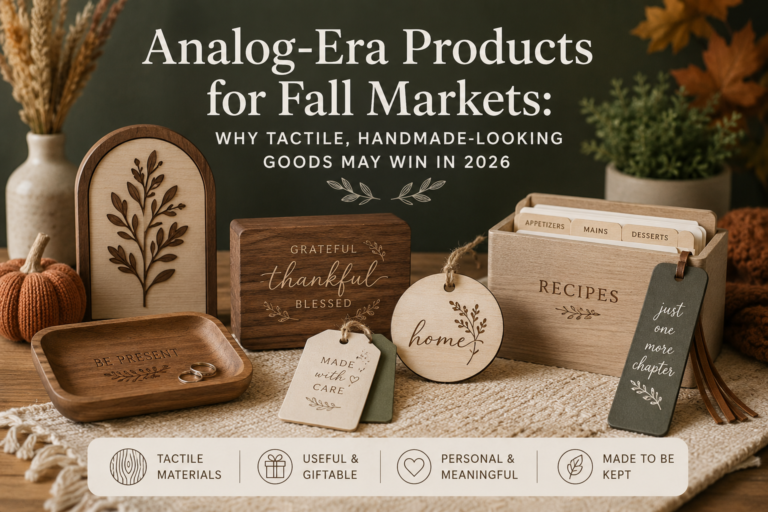
A lot of trend language sounds useful until you try to turn it into something for a market table.
“Analog-era.” “Handmade-looking.” “Tactile.” “Nostalgic.” “Personal.” “Less mass-produced.”
Those are good signals, but they’re not products by themselves. A small shop still has to decide what to make, how many to make, how to price it, how to photograph it, how to pack it, and whether the item will still make sense after one weekend of market feedback.
For fall 2026, the useful part of the analog-era trend isn’t that everything needs to look old-fashioned. It’s that buyers are responding to products that feel more human. They want texture, warmth, small imperfections, useful personalization, and objects that feel chosen instead of factory-flat.
That can be good news for laser, CNC, UV, 3D printing, and mixed-material shops, but only if the idea gets translated into products people can understand quickly.
A fall market table doesn’t reward vague aesthetics. It rewards products that make someone stop, pick the item up, imagine who it is for, and understand why it costs what it costs.
What “analog-era” should mean for a maker business
For a small product business, analog-era shouldn’t mean pretending your digital tools aren’t involved.
It should mean using those tools to create products with a more physical, personal, and intentional feel.
That can show up through:
- visible wood grain
- layered materials
- matte or soft-touch finishes
- engraved handwriting-style details
- stitched, woven, bookish, or stationery-inspired design cues
- small personalization that feels useful instead of gimmicky
- products that invite touch, not just a quick photo
- packaging that feels like a gift, not warehouse inventory
The mistake is turning the trend into costume design. Not every product needs fake vintage distressing, sepia colors, or retro fonts. Overdoing that can make the table look themed instead of sellable.
The better move is quieter: make products that feel like they belong on a desk, shelf, entry table, kitchen counter, nursery wall, market tote, memory box, or gift basket.
That’s where fall markets are useful. Shoppers are already thinking about hosting, gifting, decorating, school routines, sports seasons, local events, Halloween, Thanksgiving, and early holiday prep. They’re looking for things that feel seasonal without being disposable.
If you already have a broad fall or Q4 plan, this article is the product-assortment layer. For inventory timing and supply planning, the deeper operational guide is Q4 inventory planning for makers. This piece is about what should earn a place on the table.
The product test: would someone pick it up?
Online, a product has to stop the scroll. At a fall market, it has to earn a hand.
That’s the first filter for analog-era products: would someone physically pick it up?
Products that do well with this trend usually have at least one of these qualities:
- texture that makes the item feel better in person than in a flat photo
- a clear gift recipient
- a familiar use case
- a small personal detail
- an obvious place it belongs at home
- a finish that feels more finished than “fresh off the machine”
A laser-cut ornament can work. A CNC catchall can work. A UV printed acrylic tag can work. A 3D printed desk object can work. A handmade-looking mixed-material sign can work.
But the buyer shouldn’t need a long explanation.
If the product requires you to explain the trend before someone understands the item, the product is probably too abstract for a market table.
Product lane 1: tactile decor that is small enough to buy on impulse
The easiest way to use this trend is with small decor pieces that feel good in person and don’t require a big decision.
Think shelf-level, table-level, and entryway-level products.
Good examples include:
- layered wood shelf sitters
- small arched signs
- mini framed quotes with restrained typography
- engraved seasonal blocks
- small botanical panels
- house-number or room-marker plaques
- pet corner signs
- coffee bar or kitchen shelf accents
- small nursery or kids-room name pieces
- interchangeable inserts for a permanent base
The key is to avoid making every piece loud. Buyers who like tactile, handmade-looking goods often respond to calmer finishes: walnut, oak, maple, cream, clay, sage, black, soft blue, muted orange, and matte white.
That doesn’t mean boring. It means the product should feel easy to place in a real home.
For laser shops, layered pieces are a natural fit. For CNC shops, small carved trays, shallow relief panels, and smooth-edge catchalls can feel more premium than another text-heavy sign. For UV shops, printed acrylic or wood-acrylic hybrids can work if the finish looks intentional and not like a flat sticker.
The table test is simple: if someone picks it up, can they immediately say, “I know where I’d put this” or “I know who’d like this”?
If not, narrow the product.
Product lane 2: useful objects with warmer materials
Not every fall-market product needs to be pure decor. Useful products often sell better because the buyer can justify the purchase faster.
This is where analog-era thinking gets practical. Take everyday objects and make them feel warmer, more personal, or more giftable.
Examples:
- wood catchalls for keys, jewelry, dice, coins, or desk items
- engraved recipe card boxes
- book trackers or reading log boards
- bookmarks with wood, leatherette, acrylic, or metal accents
- desk name plates with a softer home-office feel
- coaster sets with understated local or seasonal designs
- pantry, basket, or shelf labels that look decorative
- market tote tags
- reusable gift tags
- small memory boxes
These products work because they do a job. The analog feel isn’t the whole pitch; it’s the reason the product feels nicer than the cheap version.
That distinction matters.
“Handmade-looking coaster” is weak. “A simple wood coaster set that makes a teacher gift or housewarming basket feel finished” is stronger.
The more useful the product is, the less pressure you have to put on the trend language.
Product lane 3: personalization that feels quieter and more specific
Personalization is still powerful, but fall shoppers are getting tired of products that look personalized only because a name was dropped into the same template everyone else is using.
For analog-era products, the stronger move is quieter personalization.
That could mean:
- a handwritten-style recipe engraved onto a board or card
- initials instead of a full name
- a meaningful date on the back rather than the front
- a child’s drawing converted into a simple keepsake
- coordinates or neighborhood names for local customers
- pet names on practical items instead of novelty signs
- a family phrase inside packaging or on a small insert
- event names on useful favors rather than cheap throwaways
This kind of personalization feels more considered. It also gives you room to charge more, because the buyer understands that the product is being made for a specific person or moment.
The risk is production drag. Personalized products can eat margin if proofing, file prep, messaging, and revisions aren’t controlled.
Before you add personalization to a fall-market product, decide:
- what fields the customer can customize
- whether proofs are included
- how many revisions are allowed
- how long turnaround takes
- what happens if the customer misspells something
- whether rush timing is available
If you don’t define those rules, the product may sell but still hurt the business. For that side of the workflow, review whether rush orders make sense for custom products before promising fast turnaround.
Product lane 4: market-table sets instead of isolated items
Analog-era products often look better when they are grouped.
That doesn’t mean bundles have to be complicated. It means your table should show shoppers how pieces work together.
Instead of displaying one-off items scattered across the table, build small product stories:
- a reading gift set: bookmark, bookplate, small shelf sign, gift tag
- a teacher gift set: personalized tag, desk name plate, mini card holder
- a pet corner set: leash tag, treat jar label, small hook sign
- a host gift set: coaster pair, recipe card, small kitchen marker
- a nursery keepsake set: name plaque, milestone tag, memory box label
- a craft fair impulse set: ornament-style everyday tag, mini shelf accent, reusable gift tag
The table becomes easier to shop because the buyer doesn’t have to invent the use case.
This also helps with photography. If your product line is tactile and subtle, the photos need context. A plain product-on-white photo may be useful for clarity, but styled photos sell the feeling. If that setup is weak, use the product photography setup guide before assuming the product itself is the problem.
What to avoid: fake handmade, over-distressed, and trend soup
The analog-era trend can go bad quickly.
The biggest mistakes are:
- making everything look artificially old
- adding too many fonts, icons, textures, and seasonal cues
- using “handmade” language when the product still feels unfinished
- relying on nostalgia without a useful product reason
- copying trend-board aesthetics without checking production cost
- making one complicated showpiece instead of a repeatable product family
There’s a difference between handmade-looking and under-finished.
A product can have warmth and still need clean edges, good sanding, solid adhesive, aligned layers, accurate printing, and packaging that protects it. Buyers may like a human feel, but they still expect quality.
That’s especially true for CNC products. Wood texture helps, but tearout, rough edges, poor sanding, and weak finish aren’t charming. If CNC is part of your table, the production quality still has to hold up. The CNC finishing guide on bits, feeds, and sellable wood products is worth revisiting before adding more wood SKUs.
Price the product before you fall in love with it
Tactile products can look simple and still take too long.
Layered pieces need assembly. Wood products need sanding and finishing. Personalized products need messages, proofing, and file prep. Small packaging touches can improve perceived value, but they also add cost.
Before making a full batch, price the product honestly.
Include:
- material cost
- waste and failed pieces
- machine time
- finishing time
- assembly time
- packaging
- market fees
- payment processing
- your time answering customization questions
If the product only works when you ignore labor, it’s not a good fall-market product.
That doesn’t mean every item needs a high price. Market tables usually benefit from a mix: impulse items, mid-price gifts, and a few higher-value personalized or premium pieces. But each tier needs margin.
If supplier costs or shipping have shifted since you last priced your products, don’t reuse old numbers. The guide on material and shipping cost changes for maker product pricing is the better place to reset the math, and the Product Pricing Calculator can help sanity-check individual SKUs.
How many analog-era products should you test?
Don’t rebuild your whole fall table around one trend phrase.
A better first test is three to five products across one clear theme.
For example:
- one impulse item under your lower price tier
- one practical gift item
- one personalized option
- one display-friendly decor piece
- one higher-value bundle or set
That’s enough to learn without turning the shop into chaos.
If you sell in person, watch what people touch. Not just what they compliment. Compliments are cheap. Picking something up, checking the price, asking about personalization, and naming who it’s for are better signals.
After the market, sort feedback into three buckets:
- kept picking up but didn’t buy: pricing, offer clarity, or finish may need work
- asked who it was for or what it did: use case is unclear
- bought without much explanation: possible product-family candidate
That feedback is more useful than trying to guess from trend reports alone.
A practical fall-market assortment example
Here’s what a small analog-era test table might look like for a laser or mixed-tool shop:
Impulse tier:
- reusable wood gift tags
- small bookish bookmarks
- basket labels
- mini shelf accents
Mid-price tier:
- coaster pairs
- small recipe card holders
- personalized pet corner tags
- engraved room markers
Higher-value tier:
- layered family name shelf sign
- recipe keepsake board
- small memory box with engraved plate
- host gift set with tag, coaster, and card
This gives shoppers different entry points without making the table feel random.
The common thread is touch, warmth, usefulness, and giftability. That matters more than whether every product uses the same exact color palette or font style.
The real opportunity is not nostalgia. It is trust.
The analog-era signal is easy to misunderstand as nostalgia. Nostalgia can help, but it’s not the whole business case.
The real opportunity is trust.
A tactile, handmade-looking product tells the buyer that someone paid attention. It feels less anonymous. It feels more giftable. It feels like the kind of object someone chose instead of grabbed.
That’s exactly where small maker shops can compete.
Not by pretending digital tools aren’t involved. Not by copying every trend board. Not by making products look artificially old.
The better path is to use your tools to make warmer, clearer, more specific products that hold up in the hand and make sense on the table.
For fall markets, that may be enough to win the first interaction.
And at an in-person table, the first interaction matters.
FAQ
What are analog-era products for makers?
Analog-era products are items that feel more tactile, personal, and human than mass-produced goods. For maker businesses, that can include layered wood signs, engraved keepsakes, textured decor, useful gift items, bookmarks, catchalls, labels, recipe boxes, and small personalized products.
Are tactile products better for fall markets?
They can be. Fall markets are physical shopping environments, so products that invite touch, feel giftable, and make sense in person often have an advantage. The product still needs clear pricing, good finish quality, and an obvious use case.
What should laser businesses make for fall markets in 2026?
Laser businesses can test layered shelf signs, basket tags, bookmarks, reusable gift tags, room markers, pet corner signs, recipe keepsakes, and small personalized decor. The best options are easy to understand, easy to stage, and repeatable enough to produce without hurting margins.
What should CNC businesses make for fall markets?
CNC businesses can test catchalls, trays, coasters, small carved panels, desk accessories, and decor with clean edge profiles and strong finishes. CNC products need especially good finishing because rough sanding or tearout can make a tactile product feel unfinished rather than handmade.
How many fall-market products should a small shop test?
A good first test is three to five products within one clear theme. Include one impulse item, one practical gift, one personalized option, one display-friendly decor piece, and one higher-value set or bundle if production time allows.