
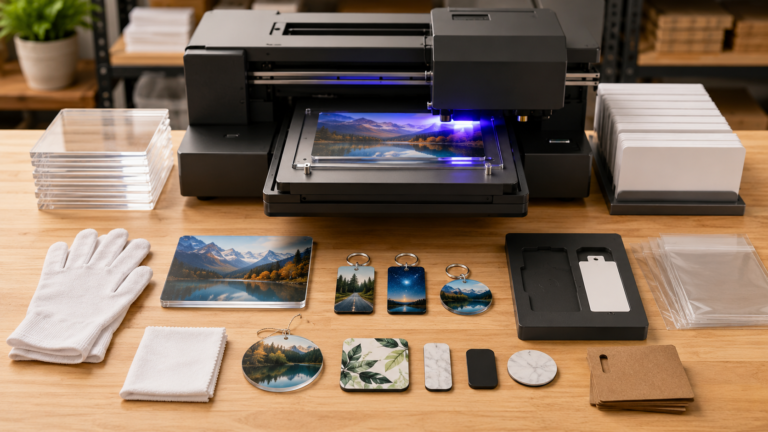
A lot of new UV printing conversations start in the wrong place.
They start with whatever looks impressive in a product demo.
That’s understandable. UV printing can make small products look polished fast. But if you’re new to the workflow, the real question isn’t “What can I print on?” It’s “What can I print on repeatably without burning time, blanks, and confidence?”
That’s the better beginner question.
The best blanks for UV printing beginners are usually not the most unusual products or the widest possible material mix. They’re the blanks that help you learn alignment, spoilage control, surface prep, packaging, and pricing without making every order feel like a science experiment.
If you’re still deciding whether the category itself makes financial sense, read Desktop UV Printing Costs: Real Per-Item Math and Margins before going too deep on product ideas. Blank selection and machine economics are tightly connected.
What makes a UV blank beginner-friendly?
A beginner-friendly blank isn’t just something a UV printer can decorate.
It’s something that helps a small shop stay stable while learning.
In practice, good starter blanks usually have most of these traits:
- a flat or mostly flat printable area
- consistent size from unit to unit
- simple positioning inside a jig or fixture
- surface compatibility that’s already understood or easy to test
- replacement cost low enough that early mistakes don’t feel catastrophic
- packaging that doesn’t erase the margin you thought you had
- enough selling value that the product is worth the setup time
That last point matters more than people expect.
A blank can be cheap and still be a bad starter product if the finished item doesn’t sell for enough to cover prep, handling, spoilage, and packaging. That’s part of the same business-model discipline discussed in Can a UV Printer Become a Standalone Business or Support a Laser Shop?. A UV printer isn’t automatically a product strategy by itself.
The best beginner blanks reduce variables
The fastest way to get discouraged with UV printing is to learn too many variables at once.
New material, curved surface, uncertain adhesion, inconsistent supplier quality, no jig, premium blank cost, and a customer deadline isn’t a healthy beginner stack.
A better beginner product line is boring in a good way. It gives you room to build repeatable habits:
- one or two blank sizes instead of eight
- a simple artwork placement zone
- predictable prep steps
- easy visual inspection after printing
- packaging you can standardize
That’s how a product line becomes real instead of staying in sample mode.
Best UV blanks for beginners
1. Flat acrylic signs and plaques
Acrylic is one of the clearest beginner-friendly categories because it fits the strengths many small UV shops are actually trying to sell: branding, signage, display pieces, desk items, and premium custom gifts.
Why it makes sense early:
- flat printable surface
- easy to standardize by size
- strong perceived value compared with simple material cost
- good fit for logos, names, QR codes, business branding, and decorative graphics
- pairs well with laser-cutting workflows if the shop already has a laser
The operator advantage is that acrylic also teaches useful habits. You’ve to think about dust, handling, alignment, edge quality, and presentation. Those are real production habits, not just print-button habits.
Where beginners get in trouble is assuming every acrylic product should be highly custom from day one. A smarter start is a small family of repeatable SKUs: maybe one desk sign size, one small plaque size, and one simple display sign format. Once those behave well, then the line can expand.
2. Coated nameplates, tags, and small business branding pieces
Nameplates, desk identifiers, locker tags, branded equipment labels, and similar flat pieces are often a stronger beginner lane than novelty gift products.
Not because they’re more glamorous. Because they can be more disciplined.
These products usually reward:
- consistent blank sizing
- repeatable placement
- simple typography-based layouts
- batch production
- cleaner margin math
They also fit nicely with a shop that wants business customers instead of only one-off gift orders. That matters if the goal is repeatability, not just social-media-friendly samples.
If you’re comparing whether to build around promotional and business-oriented products or around a machine-first hobby path, Best UV Printer for Small Business in 2026 is useful context. The better machine choice often depends on the kind of blank discipline you expect to maintain.
3. Standardized keychains, magnets, and small flat gift items
This is where beginner-friendly and affiliate-friendly can meet naturally.
Small flat gift blanks can work well when they’re standardized, low drama, and cheap enough to learn on without treating every spoiled piece like an emergency.
Good versions of this category usually have:
- a flat printable face
- a simple outline shape
- a consistent thickness
- easy storage in batches
- packaging that can be templated
What matters here’s restraint.
This category gets messy when a shop tries to offer every shape, every finish, every color, and every personalization style at once. The safer path is to choose a few blanks that can share one jig concept, one packaging flow, and one pricing structure.
That’s also where accessory recommendations become useful without getting salesy. Storage trays, jig materials, cleaning wipes, gloves, backing cards, sleeves, and mailers often matter more to margin stability than one more trendy blank does.
4. Phone grips, card holders, and other small flat accessories
These products can be attractive for beginners because they’re easy to understand commercially. People already recognize them as customizable items.
But they only make sense when the specific blank is consistent.
In this lane, the blank matters more than the idea. One supplier’s version may position cleanly and package easily. Another may introduce enough inconsistency that every short run turns into alignment drift and replacement pieces.
So this is a good beginner category only if you keep the blank list tight and test repeatability before offering broad personalization.
The real question isn’t whether the item is popular. It’s whether the item behaves the same way twenty times in a row.
5. Simple ornaments, coasters, and flat seasonal pieces
Seasonal or giftable products can be good beginner blanks when they stay flat, simple, and visually forgiving.
A flat ornament or coaster has a few advantages:
- customers already understand the product value
- artwork can often be templated
- the size is manageable
- batch production is realistic
- packaging can be standardized for craft fairs, ecommerce, or gifting
The trap is starting with overly delicate, layered, or irregular versions that create too many touch points. A straightforward seasonal blank teaches more than a complicated statement piece does.
What to look for when sourcing blanks
Most blank problems don’t show up in a product photo.
They show up when you try to run the same item repeatedly.
When evaluating a blank supplier, think like an operator.
Size consistency
If the footprint varies too much from blank to blank, your jigging and placement confidence drops fast. That matters even more for products with tight borders, centered artwork, or small text.
Surface predictability
A blank doesn’t have to be perfect. It does need to be consistent enough that your prep process makes sense. If one batch behaves differently from the next, the product line becomes harder to trust.
Protective film, scratches, and shipping damage
A blank that arrives looking retail-ready saves more than frustration. It saves inspection time, repacking time, and customer-service risk.
Pack quantity and reorder realism
A product can look profitable in ten-piece testing and become awkward when real reorder timing, storage, and supplier minimums show up. Beginner-friendly blanks are often the ones you can restock without tying up too much cash too early.
Replacement cost
Expensive blanks can still be worth it, but they’re usually not the best place to learn. Early-stage UV printing already includes normal spoilage. It’s healthier when that spoilage happens on controlled products, not on premium items that punish every misstep.
Jigging matters more than most beginners expect
A blank is only half the beginner decision. The other half is whether you can place it the same way every time.
That’s why jigs, fixtures, registration aids, and simple tray systems deserve a bigger role in product selection.
A good beginner blank is often just a good jig candidate.
Look for products that make it easy to answer these questions:
- Can I load this quickly?
- Can I tell when it’s seated correctly?
- Can I batch more than one at a time eventually?
- Can I remake the setup later without guessing?
If you already run a laser or CNC, that can be a quiet advantage. You may be able to make simple fixtures in-house. If not, buying or building straightforward jigging support is still often a better investment than adding five more blank types too early.
Primer, material compatibility, and surface prep should narrow your starter list
One of the easiest beginner mistakes is treating all printable materials like they belong in the same level of difficulty.
They don’t.
Different substrates may involve different prep expectations, different adhesion behavior, and different risk tolerance. That doesn’t mean a product is impossible. It means your starter lineup should favor materials and coatings you can keep consistent.
That’s also why beginner product selection should stay conservative.
Instead of telling yourself that a UV printer can print on almost anything, ask a stricter question: which blanks can I prep and print with a repeatable process I would feel comfortable using on customer orders?
That framing naturally pushes you toward practical support purchases too: primer where appropriate, approved cleaning supplies, gloves, lint-free wipes, surface prep materials, and test blanks. Those aren’t glamorous affiliate items, but they’re often the supplies that make the product line work.
Packaging is part of product selection, not an afterthought
A blank can print beautifully and still be a weak beginner product if packaging is awkward.
This is especially true with products that scratch, mark, or lose perceived quality quickly when handled casually.
Before you commit to a blank, think through:
- how it’ll be protected after printing
- whether the finished item needs a sleeve, box, backing card, or insert
- whether it can ship safely without oversized packaging cost
- whether its presentation matches the price you need to charge
Packaging discipline is one reason simple flat products beat complicated shapes early on. They’re easier to store, easier to batch, and easier to ship without reinventing the process every time.
If the packaging cost surprises you, run the numbers through the Product Pricing Calculator. A lot of “good blanks” stop looking good once packaging and spoilage are priced honestly.
Starter supplies that matter more than a huge blank catalog
If you want to make this article useful as a shopping checklist, don’t only think in terms of blanks. Think in terms of the support stack that makes a small blank lineup repeatable.
For most beginner UV product lines, the practical shopping list is usually closer to this:
- a small number of consistent starter blanks
- extra test pieces for spoilage and settings checks
- jig or fixture material
- gloves and clean handling supplies
- lint-free wipes or approved cleaning supplies
- primer or adhesion-support products only when appropriate for the material and printer workflow
- backing cards, sleeves, boxes, mailers, and labels
- simple storage bins or trays for keeping blank batches separated
That’s the affiliate-friendly angle that actually helps the reader. A beginner doesn’t need a giant catalog. They need a controlled product family plus the boring supplies that keep that family profitable.
Margin-friendly beginner products usually share the same traits
The strongest beginner UV products often look surprisingly similar from a business perspective.
They tend to have:
- standardized blank sizes
- a narrow artwork zone
- simple setup
- moderate or strong perceived value
- low-to-moderate spoilage cost
- easy packaging
- repeat order potential
That’s why signage pieces, nameplates, tags, simple accessories, and flat gift items keep showing up in sensible beginner lists. They aren’t just printable. They’re operable.
What not to start with
This is just as important as the “best blanks” list.
Some products may be excellent later and still be poor beginner choices.
Be careful about starting with these categories.
Highly curved or irregular items
The more placement guesswork and surface variation a product introduces, the harder it’s to learn the basics cleanly.
Expensive premium blanks
Luxury-feeling blanks can make beautiful samples, but they raise the emotional and financial cost of normal early spoilage.
Customer-supplied products
Customer-supplied items often sound like easy margin because there’s no blank sourcing. In practice, they can create more uncertainty around surface behavior, replacement responsibility, and order stress.
Products that need too many variations immediately
A product line that starts with ten colors, six sizes, and three hardware choices isn’t beginner-friendly, even if the blank itself is printable.
Anything you can’t package confidently
If you don’t yet know how the finished product will be protected, stored, and shipped, the blank is probably not ready for your starter catalog.
A practical beginner approach: start with a small SKU family
The smartest beginner move is usually not finding the single perfect blank.
It’s choosing a small group of blanks that share a workflow.
For example:
- one acrylic sign blank size
- one plaque or nameplate format
- one small gift or accessory blank
- one seasonal flat item
That gives you enough variety to learn and sell, but not so much variety that every order resets the process.
This also keeps the shopping angle useful and grounded. Instead of recommending everything in the UV ecosystem, you can build a focused support stack around the products you actually want to run: blanks, jig materials, primer where appropriate, cleaning supplies, spare test pieces, sleeves, backing cards, and shipping mailers.
Where EufyMake-style desktop UV interest fits into this conversation
A lot of newer interest in small-format UV has been driven by more creator-friendly machines and more visible consumer-facing coverage. That’s part of why product selection matters so much right now.
If you came into UV through the kind of excitement discussed in EufyMake Is Changing the Conversation Around Desktop UV Printing, this is the operator follow-up: choose products that teach control before you chase range.
That’s how you protect both margin and morale.
FAQ
What are the best UV printer blanks for beginners?
Usually flat, standardized blanks such as acrylic signs, simple plaques, nameplates, tags, keychains, magnets, and other small accessories with predictable printable areas. The best beginner blanks reduce setup variables and make spoilage easier to manage.
What products should I avoid first with a UV printer?
Avoid products that add too many variables at once: highly irregular shapes, expensive premium blanks, customer-supplied items, and products that are difficult to jig, prep, or package consistently.
Are cheap blanks always best for learning UV printing?
Not always. A cheap blank can still be a poor choice if it has inconsistent sizing, weak perceived value, or packaging costs that ruin the margin. The better question is whether the blank supports repeatable production.
Do I need jigs for beginner UV printing?
You may not need a complex fixture on day one, but repeatable positioning matters almost immediately. A blank that’s easy to jig is usually easier to turn into a real product line.
How many UV blanks should a beginner start with?
Usually fewer than you think. A small SKU family is often better than a broad catalog. Starting narrow helps you learn spoilage rates, packaging needs, repeatability, and realistic pricing faster.
Should I buy a UV printer before choosing products?
Not if you’re trying to build a business around it. You don’t need every SKU chosen first, but you should have a realistic starter product lane before buying equipment or stocking blanks. Product fit, blank sourcing, packaging, and margin math should guide the machine decision, not come after it.
Final takeaway
The best blanks for UV printing beginners aren’t the ones that prove the machine can do everything.
They’re the ones that help a small shop do a few things well.
If a blank is easy to source, easy to position, realistic to prep, affordable to spoil, safe to package, and strong enough in perceived value to support real margins, it’s probably a smarter starting point than the flashy product that looks good only in a demo.
That’s how beginners build a UV product line that can actually scale later: not by starting wide, but by starting repeatable.
[…] you’re choosing your first product family, the beginner UV blanks guide covers selection and repeatability. This guide picks up later. You already have a product, and […]