
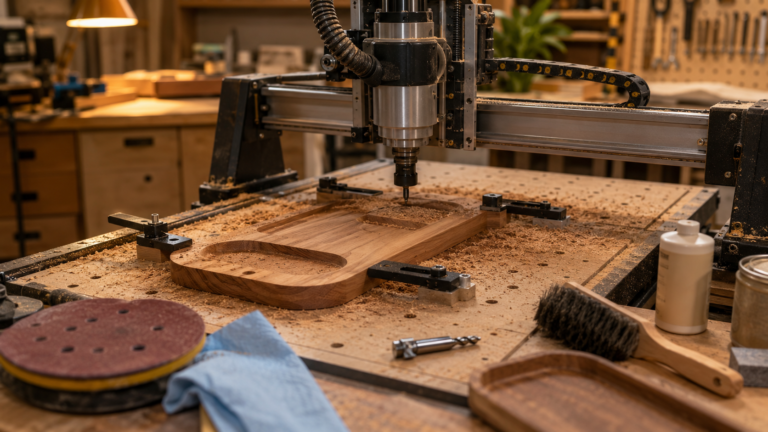
A lot of small CNC business problems don’t start with a dramatic crash. They start with a product that takes ten extra minutes to clean up, a hold-down method that works until it suddenly doesn’t, a broken bit that turns a sellable blank into scrap, or a finish schedule that quietly slows the whole week.
That’s why many CNC margin leaks look small when they happen. One ruined piece here. Fifteen extra minutes of sanding there. A batch that should have shipped today but still feels dusty, rough, or not quite ready for finish. The shop stays busy, but the numbers don’t improve the way they should.
If you need the broader machine foundation first, Laticy’s Beginner’s Guide to CNC Machines is the right starting point. For product ideas, CNC Products That Actually Sell at Summer Markets is a useful companion. This article is the business follow-up: not how to cut, but how small operating mistakes make sellable products less profitable.
Mistake 1: Treating Machine Time as the Main Cost
The carve is easy to see, so it gets most of the attention. The hidden work around the carve is where many small CNC shops undercount real labor.
Loading and aligning stock, checking hold-downs, zeroing, clearing chips, removing tabs, sanding edges, cleaning dust out of carved details, applying finish, waiting on dry time, inspecting, and packaging all belong in the cost of the product. If the machine runs for twelve minutes but the product needs twenty-five more minutes of hands-on cleanup and finishing, the real cost isn’t the twelve-minute toolpath.
This is where pricing mistakes usually begin. The owner remembers the cut time because it’s measurable and visible. The cleanup work gets remembered as “just a few minutes,” even when it happens on every single piece.
Track one or two repeat products from blank to packed order with a timer. Not theoretically. Actually time them. Then run the real numbers through the Product Pricing Calculator and compare the result with the current selling price. The goal isn’t perfect accounting theater. The goal is seeing where the margin is actually going.
Mistake 2: Choosing Products That Look Good in CAD but Drag in Finishing
Some CNC products are easy to design, easy to photograph, and annoying to produce in real life.
Tiny interior corners, deep narrow pockets, fragile details, heavy lettering, fuzzy plywood edges, and carved recesses that trap dust can all turn a simple-looking item into a finishing-heavy SKU. The product may still sell, but a product can sell well and still be weak for the business if every unit needs too much rescue work.
The better question isn’t only, “Will this sell?” It’s whether the product still works when you make ten, twenty, or fifty of them. Can it be sanded without fighting every edge? Does dust hide in the carved areas? Can the finish be applied consistently in a batch? If one edge tears out, can the piece be recovered quickly, or does it become scrap?
Creative design matters. But if the cleanup load doesn’t match the selling price, the design is quietly asking the shop to subsidize the customer.
Mistake 3: Letting Workholding Stay “Good Enough” Too Long
A lot of small CNC waste starts with workholding that’s almost reliable.
The stock may not fully shift. It may only flex slightly, vibrate on one edge, lift during a profile cut, or sit inconsistently from job to job. That’s still enough to create chatter, rough edges, uneven depths, bad registration, or a part that suddenly needs more sanding than expected.
The operator mistake is tolerating that uncertainty because the setup worked last time.
Clamps, tape-and-CA methods, threaded inserts, low-profile hold-downs, fixture plates, and simple jigs all have a place. Problems start when a shop uses the same familiar method on parts that need something more stable or more repeatable. A one-off sign can often survive a slower improvised setup. A repeat SKU usually can’t.
If you make the same tray, organizer, sign, plaque, or coaster set regularly, a simple fixture may be a better business upgrade than another bit. It can reduce alignment drift, speed setup, lower scrap risk, and make the next batch feel less like a gamble.
Review your top repeat product and ask whether the current hold-down method improves speed, repeatability, and confidence at the same time. If it doesn’t, the next fix may be fixture hardware, spoilboard inserts, low-profile clamps, or a more repeatable jig setup.
Mistake 4: Treating Broken Bits as Only a Tooling Expense
A broken bit isn’t just the cost of replacing the bit.
In a small shop, it can also mean a ruined blank, a partially finished piece that becomes scrap, lost setup time, re-zeroing, test cuts, delayed orders, and lower confidence on the next run. That’s why broken-bit costs add up faster than the invoice for tooling alone.
This isn’t a claim that every broken bit comes from operator error. Materials vary. Machines vary. Accidents happen. But shops create extra tooling and scrap costs when they push dull bits too long, skip stock-flatness checks, trust weak holding on small parts, rush a setup because the last batch worked, or test a risky cut on a paid blank.
The business question isn’t “How much was the bit?” The better question is “What did that failure interrupt?” If the answer includes material, schedule, customer delivery, or an almost-finished personalized order, the cost is bigger than it looks.
If you’re evaluating compact-machine fit for repeat work, Makera Z1 for Small Business is useful context for where a smaller CNC can fit and where production expectations still need discipline.
Mistake 5: Pricing Sanding and Finishing Like Minor Cleanup
This is one of the most common CNC business mistakes because the labor feels too ordinary to count carefully.
But ordinary labor is still labor.
If a cut leaves fuzz, tearout, rough walls, packed dust, sharp edges, or inconsistent pockets, someone has to fix that by hand. The work may happen in short bursts, which makes it feel smaller than machine runtime, but the total still matters.
Finishing also creates bottlenecks that don’t show up in the toolpath preview. A product line that looks efficient on the machine can still clog the week if pieces need extra prep before stain, more dust removal before topcoat, or longer cure time before packaging. A defect found after sanding, stain, or topcoat costs more than the same defect caught earlier because labor has already been invested.
Build a standard finishing sequence for repeat products. Define what acceptable surface quality looks like before finish, what grit progression is normal by product type, how dust gets removed before coating, where pieces dry or cure, and what gets checked before packaging.
The point isn’t to make the shop rigid. It’s to stop every product from becoming a fresh judgment call.
Mistake 6: Treating Dust as Only a Cleanliness Issue
Dust control matters for health and shop comfort, but it’s also a production issue.
Fine dust affects visibility, chip evacuation, cleanup time, finish prep, machine maintenance, and how professional the workflow feels when orders stack up. It can hide in carved details, contaminate stain or topcoat, and make the machine area feel reset when it really isn’t.
That friction compounds. Dust slows setup. It slows inspection. It makes finishing less reliable. It can also make the shop feel chaotic, which usually leads to more missed details over time.
Keep the standard boring and consistent: confirm extraction before the batch starts, clear chips before they affect visibility or edge quality, clean carved recesses before sanding and before finish, and keep the finishing area separate enough that dust doesn’t undo prep work.
Cleanliness is part of the business model when dirty workflow keeps stealing time.
Mistake 7: Ignoring Spoilboard and Measurement Drift Until Quality Gets Weird
Some CNC quality problems feel mysterious until you realize the work surface is no longer helping you.
A worn or uneven spoilboard can contribute to inconsistent depth, weak through-cuts, onion-skin variation, and extra cleanup in random-looking places. If the shop also isn’t checking stock thickness or finished dimensions often enough, small errors pile up without anyone naming them.
This is different from a dust problem or a finishing problem. It’s a repeatability problem. The machine may be doing exactly what it was told to do on a surface that’s no longer giving it a stable reference.
Resurface or replace spoilboards before depth inconsistency becomes normal. Use calipers when stock thickness looks suspicious. Measure finished parts occasionally instead of trusting appearances. When repeatability starts drifting, inspect whether the problem is really the setup, the surface, or the material before blaming the design file.
The earlier CNC Bits, Feeds, and Finishes for Wood Products That Sell in 2026 covers the cut-quality side. This is the operating side: even a decent toolpath can’t fully rescue weak shop habits.
Mistake 8: Confusing One Successful Piece With a Repeatable Product Line
A small CNC business usually doesn’t improve because one piece came out beautifully. It improves because the second, tenth, and fiftieth piece come out close enough that labor, finishing, and packaging stay predictable.
A product isn’t really repeatable if the setup changes too much between runs, cleanup time varies wildly, workholding feels improvised each time, finish appearance shifts more than the brand can support, or scrap risk still feels emotionally expensive on every batch.
Before scaling a product, run a short batch and document what actually happened. Note setup time, cut time, cleanup time, finishing time, dry or cure delay, scrap or near-scrap moments, and which step felt least controlled.
That gives you a better business decision than a single good sample ever will.
A Healthier Standard for a Small CNC Shop
A profitable CNC workflow usually looks less exciting than social media makes it sound.
It often means simpler products that finish well, stable workholding, bits replaced before they become a false economy, dust kept under control, spoilboards maintained on schedule, and pricing based on real labor instead of optimistic carve time.
That isn’t glamorous. It’s how a product line gets easier to trust.
The compounding pattern matters: weak holding creates rougher parts, rougher parts need more sanding, sanding creates more dust, dust makes finishing less reliable, and unreliable finishing makes repeat production harder to price. None of those problems has to look dramatic to hurt the business.
FAQ
What Is the Most Common Small CNC Business Mistake?
One of the most common mistakes is undercounting everything that happens after the cut. Sanding, dust removal, finishing, dry time, inspection, and packaging often erase more margin than the visible machine time suggests.
Why Does Workholding Matter So Much for Profitability?
Unstable stock creates more than safety risk. It can create rough edges, inconsistent depth, chatter, misalignment, and extra hand cleanup. Even small movement can turn a repeatable product into a labor-heavy one.
Are Broken Bits Mostly a Tooling Cost Problem?
Not usually. In a production setting, the larger cost is often the ruined blank, lost time, interrupted batch, and delayed order attached to the bit failure. The replacement bit is only one part of the loss.
How Do I Know If My CNC Finishing Time Is Too High?
If sanding, dust cleanup, stain prep, coating, or cure delays are regularly longer than expected, or if they force you to keep raising effort without raising price, finishing time is probably being undercounted in the business model.
Final Takeaway
Many small CNC shops don’t fail because the machine can’t cut. They struggle because hidden labor keeps outrunning the price.
If your products feel harder to profit from than they should, look closely at the quiet mistakes: counting carve time more carefully than finish time, accepting weak workholding, normalizing dust, postponing spoilboard maintenance, and treating broken bits like isolated bad luck instead of business signals.
The fix is usually not a more dramatic product idea. It’s a calmer, cleaner, more repeatable process.